



 10 / 40

10
Australian Journal of Dementia Care
December 2016/January 2017 Vol 5 No 6
of the TimeSlips concept,
through the development and
dispersal of resources, to the
Penelope Project.
Using the story of Homer’s
The Odyssey
, a team made up
of staff, residents, artists and
students involved an entire
long-term residential care
community in a creative
enterprise.
Finding Penelope
was the performance which
resulted, but the journey took
in discussion groups,
movement exercises, visual
art, storytelling and music. A
two-year preparation period
culminated in performances in
March 2011, attended by over
400 people. All the activities
took place in Luther Manor
Care Facility in Milwaukee.
The narrative of Penelope’s
rejection of 108 suitors during
her husband Odysseus’
absence was chosen because it
was considered important to
encourage the residents to feel
that they were participating in
an event which had a timeless
aspect, even though the action
had a contemporary location.
The basic storyline had
resonances for long-term
residents because they too
were playing ‘a waiting game’.
Anne indicates the further
ideal of the project in the
following words:
“Much of this
work is about inviting people to
be open to creativity in an
environment which too often
stultifies it.”
She also stresses
the intergenerational nature of
the project.
As the play evolved, the
original story was turned on
its head. As one of the
producers states:
“There are 100
Penelopes. There is a Penelope
story in everyone”
. So 100
suitors search for Penelope
and find themselves. An actor
states:
“You are the ones who
make the place home”
. All 100
residents then chorus:
“If the
gods will grant us a happier old
age we’ll be free from our trials at
last”
.
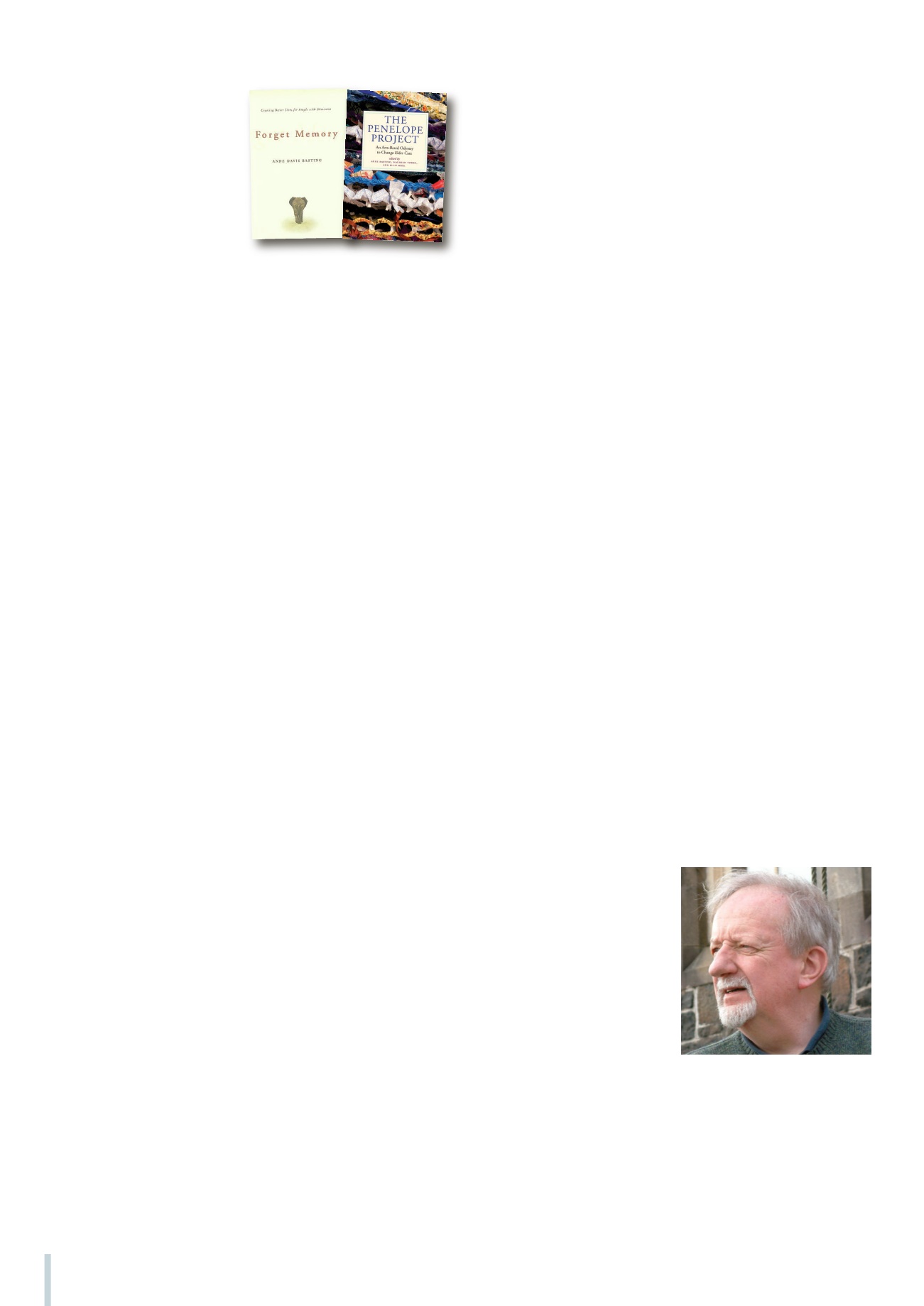
The resulting book,
The
Penelope project
(Basting
et al
2016), provides revealing
snapshots of the process as
well as practical advice for
realising similar holistic
initiatives in diverse settings.
Acknowledging that the
project was site-specific,
though it could be realised in
other forms in other facilities,
Anne then wanted to address
the needs of the 85% of older
adults in America who live in
their own homes, many
experiencing the early stages
of dementia. She has gone on
to create plays which cater for
this larger population.
Forget Memory
Anne’s book
Forget memory
is
one of the key texts of the
creativity movement. Her
main thesis is that putting too
great an emphasis on memory
loss distorts the public view of
dementia and inhibits
progress towards psychosocial
goals.
The two main sections of the
book are devoted, first of all,
to the public perception of
dementia as adduced by
media coverage and biases,
and secondly, to positive
accounts of projects in the US
which enhance people’s
quality of life. All the projects
are arts-based and the
accounts of them form the
substance of the book.
The justification for all this
activity is made in two short
sections at the beginning and
end of the text; far more
convincing are the accounts
themselves, which are vividly
written and provide a
conclusive demonstration of
the value of these initiatives.
Apart from TimeSlips the most
original of these is To Whom I
May Concern, which provides
a format and a script for those
with early memory loss to act
out their predicaments. Anne
comments:
“With memory loss
and dementia, repeating or even
expressing one’s thoughts or
actions becomes the
quintessential challenge. Family
and caregivers might complain
about the opposite
–
that people
with dementia repeat themselves
constantly. But the meaningful
moments of exchange and self-
expression can seem to evaporate
in a heartbeat. Or by the time a
person with memory loss pulls
together thoughts and the courage
to share them, the conversation
has already moved so far
downstream he or she doesn’t
bother to enter it”
(Basting 2009
p87).
One chapter is an evaluation
of the autobiographies of
people with dementia. She
puts her finger on the main
characteristic of Thomas
DeBaggio’s book
Losing my
mind: an intimate look at life with
Alzheimer’s
(2002): “
It seems
weighted more towards the shock
of his mortality at what he sees as
the height of his career than a
description of the actual
symptoms of his condition”
(Basting 2009 p147)
.
And the message of the
writer David Greenberger,
who works with people with
dementia, she sums up as: “
Be
where they are. Concentrate on
the sublime and ephemeral
moments of a conversation. And
let the brain go faster than the
mouth”
(Basting 2009 p133).
In passages such as these
Anne makes judgments of real
cogency.
In the section of media
discussions she comes out in
favour of the film
Finding
Nemo
, ostensibly nothing to do
with dementia, as an
enlightened portrayal of
mental confusion.
Forget memory
is packed
with stimulating ideas,
copious notes, lists of images
and stories, and descriptions
of programs. It is an
invaluable resource.
Having explored
multifarious ways in which
people’s lives can be enhanced
by taking advantage of creative
opportunities, in the last
chapter Anne returns to the
subject of memory and makes a
series of points, some obvious
and some less so, about the
nature of this absorbing but
mysterious capacity of the
human. If I were to single out
one of these for special
emphasis it would be this:
“
We must remember that
memory is social, that the
‘self’ is relational.
To forget this
is to ignore one of our best ‘cures’
for memory loss
–
creating a net
of social memory around a person
whose individual control of
memory is compromised. This
doesn’t mean that we should
visit
people more. This means that
people with memory loss need to
be reknit into the fabric of our
lives”
(Basting 2009 p161).
Outstanding achievement
In 2016 Anne was awarded
one of the prestigious
MacArthur Fellowships, for an
outstanding achievement in
community service and
development. With her
passion and dedication, we
can confidently expect further
impactful contributions to the
creativity debate in the coming
decades.
References
Basting A (2009)
Forget memory:
creating better lives for people with
dementia.
Baltimore: The Johns
Hopkins University Press.
Basting A, Towey M, Rose E (2016)
The Penelope Project: an arts-
based odyssey to change elder
care.
Iowa City: University of Iowa
Press.
Thomas DeBaggio (2002)
Losing
my mind: an intimate look at life
with Alzheimer’s.
New York: The
Free Press.
To read more about the
TimeSlips program, visit the
AJDC
website at:
http://journalofdementiacare.com/the-freedom-to-imagine/
John Killick has worked as a
communicator with people with
dementia for more than 20 years,
has edited six books of poems by
people with dementia and written
many articles and books about
person-centred care,
communication and creativity.
Contact him at:
johnkillick@dementiapositive.co.uk