


 6 / 40

6
Australian Journal of Dementia Care
December 2016/January 2017 Vol 5 No 6
N E W S / L E T T E R
SHARE
YOUR
VIEWS
AJDC
welcomes Letters to the Editor on any subject related to dementia care. Letters can be
emailed to Executive Editor Professor Richard Fleming at
rfleming@uow.edu.au. Please
include your full name, address and phone number for verification. Only your name and city
will be published. Letters may be edited, with the writer’s permission, before publication.
I
refer to Christine Bryden’s
article
BPSD: alternative
understanding of a well-
accepted term
(
AJDC
5(5),
October/November 2016),
proposing that ‘Basic Personal
Signs of Distress’ is a more
appropriate term to describe
the effects of dementia on a
person’s behaviour. Citing
Alzheimer’s Australia
Dementia language guidelines
(2014), Christine makes a valid
argument for the use of non-
stigmatising language in all
matters of dementia care.
I support Christine’s
proposal to move from a
clinical to a person-centred
focus on care for a person in
distress with dementia.
However, choosing words to fit
the acronym ‘BPSD’ will
require qualification of the
context, such as ‘BPSD
Clinical’ and ‘BPSD Care’.
Given the key words are
‘
signs of distress’ as they apply
to a person with dementia, the
term could be ‘Personal Signs
of Distress in Dementia’ with
the acronym PSDD.
‘Personal Signs of Distress in
Dementia’ relate directly to the
lived experience of the effects
of dementia on a person’s
behaviour and underscores
their need for reassurance and
comfort. In addition, the words
indicate the person’s
behaviours are not wilful.
In turn, knowing the person
is in distress, carers are more
likely to adopt an empathetic
response to restless and
psychological behaviours. This
would assist the person with
dementia to feel that their carer
acknowledges and has respect
for their unmet needs.
However, a change in
terminology does not remove
the need for carers to
understand the various types
of BPSD that occur, as defined
in the Dementia Collaborative
Research Centre’s
A guide for
family carers. Dealing with
behaviours in people with
dementia
(Burns
et al
2014).
Moreover, as I outlined in a
previous letter to
AJDC,
the
need for carers to gain
interaction skills remains, ie:
• Allow the person to feel
socially included, especially
in the presence of others.
• Reduce anxiety using
person-centred care, a daily
care routine and calm,
empathetic communication.
• Validate the person’s distress
and provide reassurance and
comfort.
• Ensure activities are
enjoyable and within the
person’s level of ability.
In summary, ‘Personal Signs
of Distress in Dementia’ moves
the BPSD debate into the realm
of dementia care practices that
follow diagnosis. From my
perspective as a family carer, I
believe I would have
understood and cared for my
wife’s behavioural distress
much better with the words
‘Personal Signs of Distress in
Dementia’ rather than the
frightening ‘Behavioural and
Psychological Symptoms of
Dementia’
.
Paul Williams, Sydney, NSW
References
Alzheimer’s Australia
Dementia
language guidelines
(2014).
Available at:
http://bit.ly/2fGXIWIBurns K, Eyers K, Brodaty H (2014)
A guide for family carers. Dealing
with behaviours in people with
dementia.
Dementia Collaborative
Research Centre - Assessment and
Better Care, University of NSW.
Available at:
http://bit.ly/2e4KKSd‘PSDD’ an alternative to ‘BPSD’
It should be mandatory for
doctors to report patients
diagnosed with dementia to the
Roads and Maritime Service
(RMS), Alzheimer’s Australia
NSWhas recommended in a
new discussion paper,
Driving
and dementia
.
The paper, released in
November, recommends
mandatory reporting by health
professionals to ease confusion
around the legal and licensing
requirements when it comes to
driving and dementia.
Alzheimer’s Australia NSW has
found there is a lack of
information and understanding
around what is required by
drivers who have a diagnosis of
dementia, little clarity around
the role of doctors in this area
and a lack of information and
support regarding alternative
transport options.
Alzheimer’s Australia NSW
CEO John Watkins said it is not
mandatory in NSW for doctors
to report that a patient has
dementia to the RMS.
Currently it is the driver’s
responsibility, but many are
not aware of the requirement.
“Doctors only do so if they
are concerned that a person
with dementia is driving when
they should not be. This can
place them in a difficult
position and can be seen by
their patient as the cause, if
their licence is revoked, which
can impact on their on-going
relationship with their patient.
If reporting is made
mandatory, if removes the
need for this discretion and
takes it out of the hands of the
physician,” Mr Watkins said.
Other key recommendations
in the discussion paper are:
improved guidelines for
medical professionals to
support their role with patients
in the transition from driver to
non-driver; the NSWRMS to
develop a Driving and
Dementia information pack for
doctors to give to patients at the
time of diagnosis, and which is
also available to Aged Care
Assessment Teams, dementia
advisors and other health
professionals; subsidise the cost
of on-road driving assessments;
and streamline communication
between doctors, the RMS and
occupational therapists who
perform the on-road
assessments.
A copy of the discussion
paper, along with the full list
of recommendations, can be
found at https://nsw.
fightdementia.org.au/nsw/research.
Driving and dementia recommendations
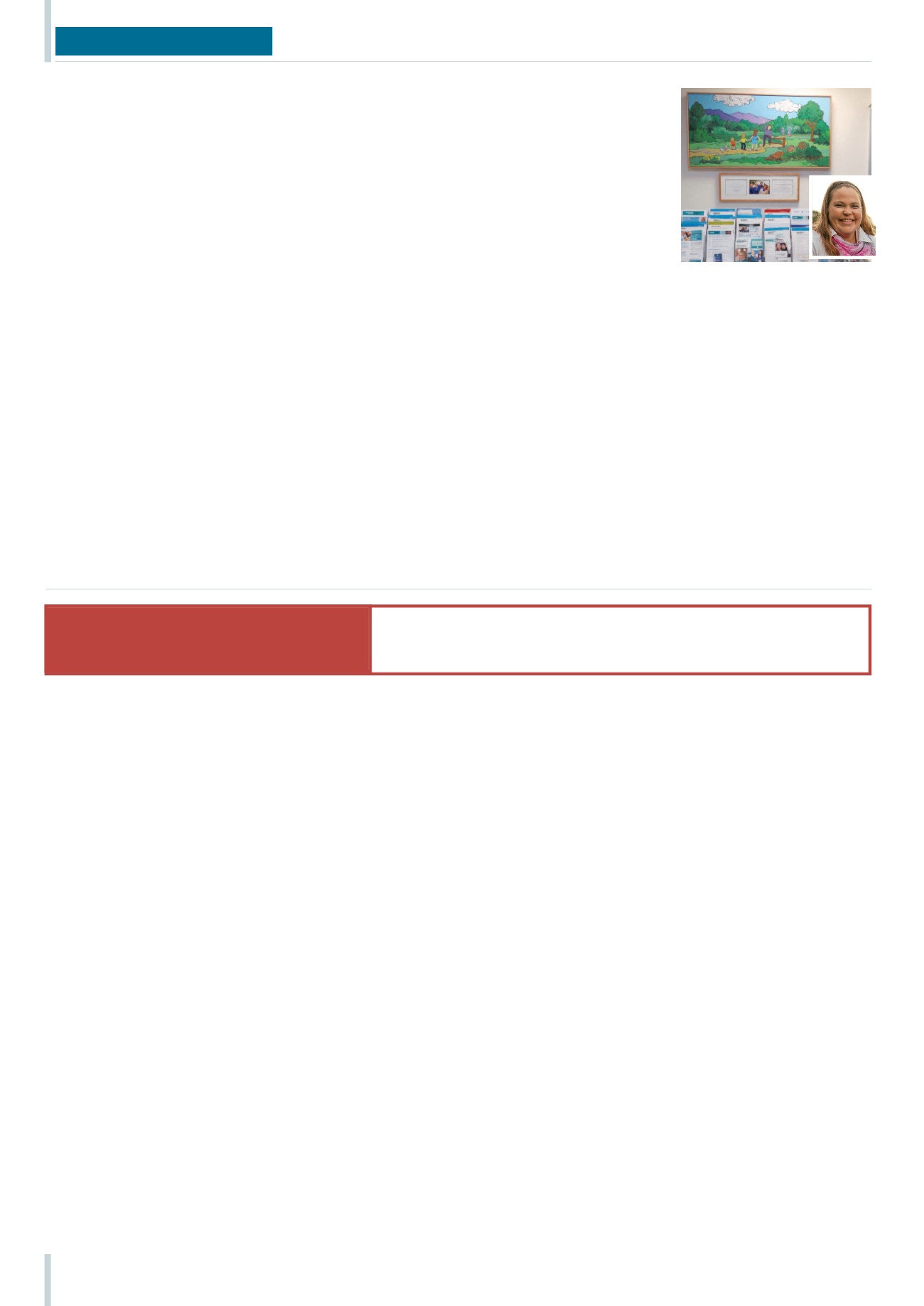
Mural a tribute to Sarah:
Victorian
mother-of-three Sarah Gorfine
(pictured), who featured in an
AJDC
article earlier this year about raising
awareness of younger onset
dementia, passed away peacefully at
her home in Geelong in October. The
mural pictured above was designed
by Russell Danby and painted by
Sarah’s family, friends and
community members to reflect her
journey and as a tribute to her life. It
now hangs in the Barwon Health
Memory Clinic, McKellar Centre, in
Geelong. Sarah was diagnosed with
Alzheimer’s disease four years ago,
at the age of 34, and visited the clinic
in the early stages of her illness.
Photo of Sarah: Sara Taylor