



 19 / 40

Vol 5 No 3 June/July 2016
Australian Journal of Dementia Care
19
W
hat makes a day a great day for
you? Is it having a chat to a friend
on the phone, being in the garden,
reading a book, going to work? Perhaps
it’s going dancing, seeing a movie, doing
some exercise or going for a walk?
In the aged care facilities that you work
in and manage, what makes a great day
for a resident? What is the vision for what
makes a day great?
Where is the variety?
I was fortunate to be able to visit some
aged care facilities in the Netherlands in
March this year, but I came away feeling a
bit sad. Not because of what I saw, but
because whereas once I was confident to
say that Australia was ‘right up there’ in
terms of dementia care practice and
environmental design (trialling new ideas,
testing the boundaries, offering
alternatives, exploring what is possible),
now I feel there is a big difference between
our two countries.
While there are some notable
exceptions, here inAustralia it seems to
me that we have too often opted for a
fairly uniform approach to residential
aged care, a predictable type of facility
design and resident experience, with little
variety and individuality in what is
offered.
I expect many
AJDC
readers will be
annoyed with me for saying this, but I
would ask you to stop and think whether
things are really as good as they could be?
Would you say you are challenging the
status quo, often reconsidering what is
possible, looking for new ideas? Are you
looking forward to living in one of your
facilities? Are you looking forward to
enjoying great days there? What would
make a day a great day?
The Netherlands experience
When I visited the facilities in the
Netherlands, two things seemed to be
particularly important in all of themdespite
their many differences: living as part of the
community and in tune with the wider
neighbourhood, and connecting with the
outdoors. If you have ever been to the
Netherlands youwill recognise the typical
Dutch street frontages in the photos on this
page, which are just like the surrounding
neighbourhoods inmany Dutch cities.
Outdoor spaces
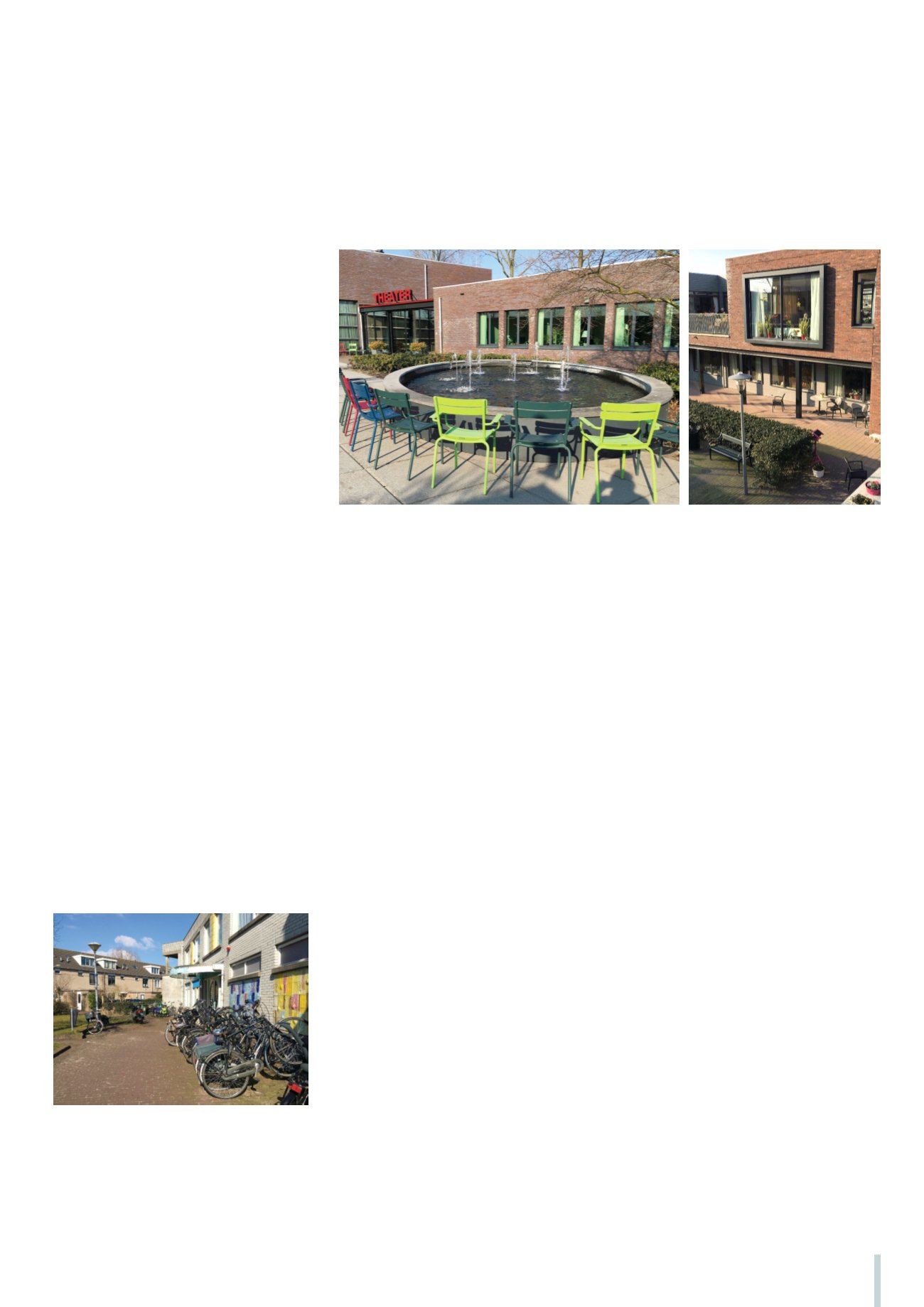
While in the Netherlands I visited De
Hogeweyk, the nowwell-known Dutch
village for people living with dementia in
Weesp. I was struck by the amount of
outdoor space they had and the way it was
used. There were courtyards, gardens,
terraces, walkways, streets and lanes.
Chairs around a fountain reminded me of
the Tuileries Garden in Paris. It was a cold
day when I visited (6 degrees Celsius), but
I met a number of residents, rugged up
and out walking using their walking
frames. De Hogeweyk is well known for
the community it creates within its
perimeter: it has a village atmosphere with
a main street, shops, cafes and a
supermarket. While some residents were
walking to the café or restaurant, it seemed
to me that many were simply enjoying
being outdoors, walking through the
courtyards, heading toward the garden,
sitting down in places that were inviting.
They weren’t being held back by the
weather, the possibility of falling, or not
being readily seen by staff. Instead they
were encouraged to explore and
investigate, to do their own thing.
Houses full of life
While in the Netherlands I also returned to
Anton Pieckhofje, a small facility in
Haarlem that I had visited in the 1990s. It
was so lovely to see these houses still full
of life and welcome. Asmall-scale setting,
it’s part of the neighbourhood with bikes
parked out the front, people with
dementia living on the ground floor and
members of the wider community in
apartments on the first floor.
Designed around a courtyard, the
houses reflect the almshouses common in
Haarlem and other Dutch cities where
people live in privacy around a semi-
public garden. Residents of Anton
Pieckhofje can come and go as they wish
to visit other houses in the ‘hofje’, spend
time outdoors, or sit in the sheltered
sitting areas which look out to the garden
and are warmed by the sun on a winter’s
day. Despite it being the end of winter,
the courtyard garden was alive with
plants and there was a strong feeling of
spring coming. The garden is large
enough to wander in, to sit in, to be alone
Making a day a great day
Are we really focusing on the most important things in residential aged care facilities? Do we offer
opportunities for residents with dementia to enjoy life, pursue their interests, be themselves? Is the focus
on life, possibilities and opportunities or routine, regulations and difficulties?
Kirsty Bennett
offers her view
Residents at De Hogeweyk, the Dutch village for people with dementia, are able to explore
the many outdoor courtyards, gardens, terraces, walkways, streets and lanes, even in
colder weather
Bikes lined up outside the front entrance to
Anton Pieckhofje apartments, a small facility
for people with dementia in the Netherlands,
where residents have easy access to the
outdoors in a secure setting that is very
much a part of the neighbourhood