


 25 / 40

Vol 5 No 3 June/July 2016
Australian Journal of Dementia Care
25
intention was for the students to
understand the basic nature of the
condition from experts, and to be
presented with a range of built solutions.
The practitioners shared valuable
information in the early stages of the
design studio and later participated in
critique sessions of the students’
preliminary work, which informed the
final designs.
As with all building designs, the
students needed to develop empathy with
the client and understand their specific
needs – in this instance the client being the
person with dementia. Students needed to
see and experience the nature of the
disease, the way in which residents relate
to the built environment, and the
appropriateness or otherwise of existing
buildings. Some students were able to do
this by visiting relatives in care, while
others were able to arrange a personal visit
to a home known to them.
Most students selected this topic
because of personal experience within
their own family. In the case of students
with a close relative with dementia, the
personal and family contact and
experience was invaluable in sensitising
them to the importance of the topic and
the problems that might be addressed
through improving the built environment.
Alzheimer’s Australia Vic has
developed a most impressive Virtual
Dementia Experience (VDE) at its centre in
Parkville, Melbourne that has assisted the
dementia design program students
understand the environmental elements
that are helpful or can hinder a person
with dementia. It is a multi-sensory
simulation using light, sound, colour and
visual content projected onto a large screen
to create the virtual reality experience of a
person with dementia.
We are deeply appreciative to
Alzheimer’s Australia Vic for making the
VDE accessible to our design program
students. The impact of a group of
strangers descending on the private space
of a dementia-specific facility can be
disruptive and insensitive. The VDE is an
excellent and non-intrusive alternative to
such site visits.
The course
The Designing for Dementia program had
to fit into a university semester of 13 study
weeks, and comprised 50% of the study
load. A lot was expected of the students. In
this time they:
• Researched the nature of dementia and
related disorders.
• Conducted literature surveys.
• Engaged in site visits.
• Attended lectures on related issues.
• Produced a joint report on core issues.
• Individually designed a project and
illustrated this in detail.
• Produced a written thesis to outline their
research and their design proposal.
The students produced a group report,
each taking one key section of the
established dementia design principles,
which then informed the design process.
The topics investigated were based on the
Environmental Audit Tool (EAT) (Fleming
2011), plus additional insights, and
available research on:
• Unobtrusively reducing risks.
• Providing a human scale and small
group size.
• Enabling residents to see and be seen.
• Reducing unhelpful stimulation.
• Optimising helpful stimuli.
• Providing purposeful wandering and
wayfinding cues.
• Creating familiar spaces.
• Providing opportunities for privacy and
community.
• Incorporating links to community.
• Developing opportunities for domestic
activities.
Some students delved into other
relevant design implications such as:
• Era-appropriate settings.
• The negative effect of strong patterns in
floor and wall surfaces.
• The positive use of colour psychology.
• The need for good quality, even lighting
levels, with an avoidance of glare.
• Culturally appropriate planning,
settings and customs.
• Designing for the senses.
The designs
The students produced dementia-friendly
building designs, responding to the
influence of environment on human well-
being. They selected a range of sites and
various solutions applying the identified
research. All sites were well located within
established communities, community
facilities and areas of interest. All sites were
near housing, shops, schools, libraries,
churches or mosques, and in one case near
an active art and craft community.
Some designs were for residential care
facilities, and several were for community
living or low-care supportive
environments. One included
accommodation for relatives who were
support carers overnight. Several Asian
students chose projects to answer a range
of demands and needs inMalaysia.
Following the initial design course in
2012, two final year overseas students
continued this area of investigation in a
Design Thesis project during 2013
.
One of these designs created a 15-storey
high-rise apartment building in central
Kuala Lumpur, close to commerce and
commercial centres, rail services, and a
mosque. It was intended specifically for
wealthy people who can afford luxury
accommodation and personal care
support. The project incorporated shops
and cafes, as well as a senior citizens’
centre, day care, counselling and
educational services and a child care centre
on the ground floor, all accessible to the
wider community. Some upper floors were
devoted to recreational and educational
activities.
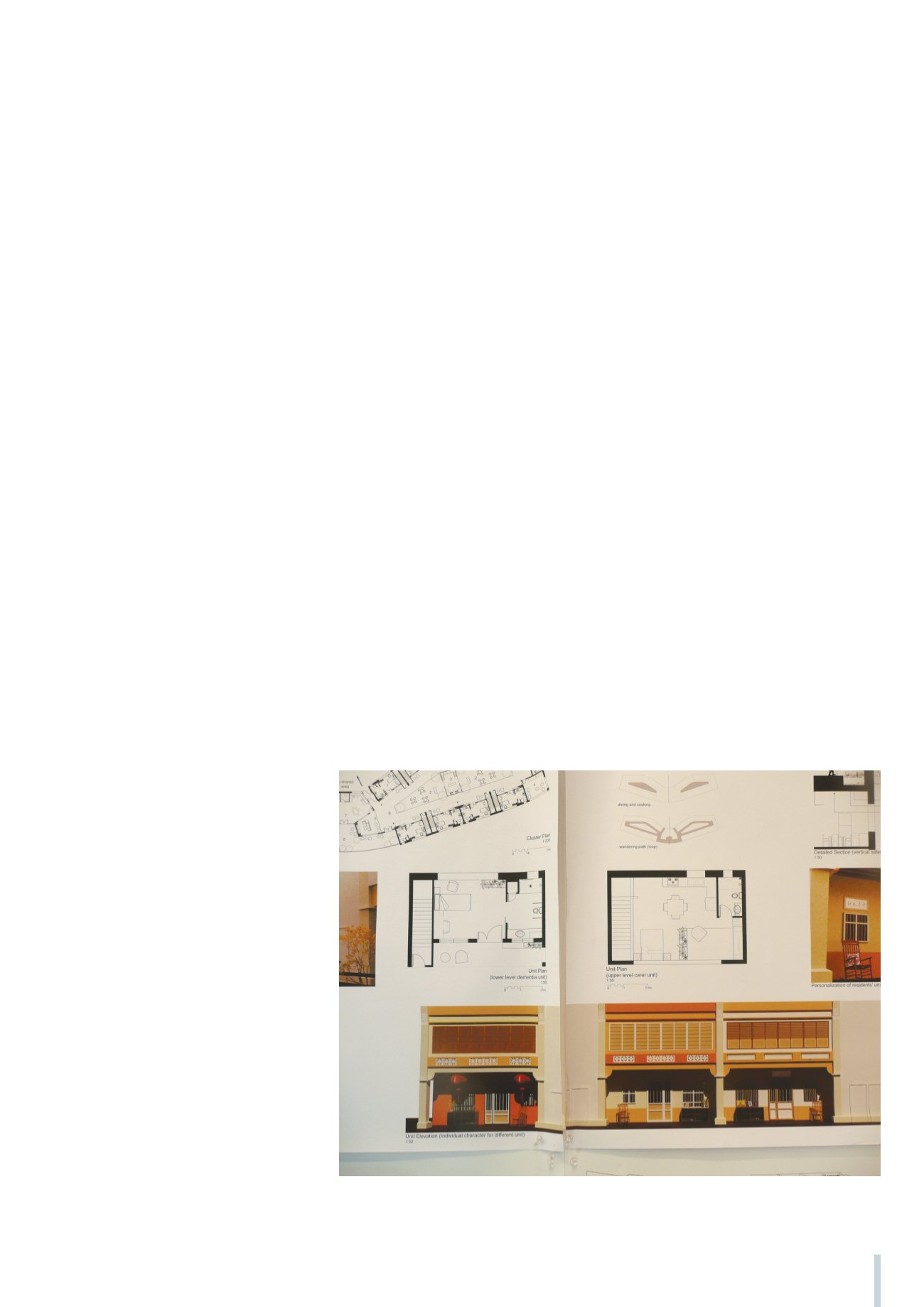
Hong Sheng Low’s design for Penang, showing culturally appropriate architecture and a
bedroom with a unit above for an overnight carer