


 28 / 40

design in diminishing these barriers.
Unfortunately, radically altering the
built environment to achieve a barrier-
free public realm is a long and difficult
process; one that is too often costly and
fraught with regulation. Recent
technological developments, however,
hint at a possible workaround.
Augmented reality
Our world is increasingly one of assistive
technologies and wearable ‘smart’
devices. Products like Google Glass (an
optical head-mounted display or
‘wearable’ created by technology giant
Google) are designed to radically alter
our perception of the physical
environment by modifying the visual
and audial information available to
users. This modification is achieved by
digitally superimposing information
onto our map of the real world,
providing targeted information intended
to enhance our sensorial experience, or
our cognitive capabilities; hence the
phrase,
augmented
reality (AR).
Just as the benefits of virtual reality are
emerging, AR is on the verge of
becoming a powerful tool in the hands of
designers and healthcare professionals.
The adaptability and relative
affordability of AR – not to mention the
promise of entirely new applications – is
quite appealing compared to the
inertness and expense of design in real
life (RL). This enhancement of reality has
the potential to compensate for the
inadequacies inherent in our built
environment.
My research, presented in my
architecture design thesis on Designing
for Dementia (submitted to the
Melbourne School of Design), explores
the potential for AR to complement
sensory data gathered from the physical
world. This article gives a brief account
of that research.
My thesis is an exercise in speculative
design and hypothesises a wearable
augmented reality device designed to
assist people with mild or prodromal
dementia to navigate the public realm. I
call this fictional device the ‘Public Realm
Orientation device’ (PRO-d).
This fictional proposal seeks to move
dementia care beyond the confines of
therapeutic architectures (real and
virtual), into the public realm and into
the hands of people with dementia.
While the particulars of the PRO-d are
purely speculative, similar enabling
devices are already under trial (notably
the ‘Moving Through Glass’ application
for Google Glass, designed to alleviate
mobility difficulties in people with
Parkinson’s disease).
The PRO-d is an assistive technology
designed for people with dementia, to
aid navigation in the public realm; on
trips to the local shopping precinct, or to
visit friends and neighbours. Attached to
a standard pair of spectacles, the PRO-d
provides users with a digitally enhanced
environment, improving visual legibility
and providing navigational prompts if
necessary. By reducing barriers to
accessing the public realm, this
augmentation of the RL environment is
aimed at enabling people with dementia,
along with other visually or cognitively
impaired people, to maintain a strong
connection to their community and to the
environment.
To guide designers in the development
of this fictional device, I developed a set
of seven design principles specifically
addressing the dementia experience in
the public realm. I then translated these
principles from real life (RL) to the
augmented realm using a hypothetical
28
Australian Journal of Dementia Care
June/July 2016 Vol 5 No 3
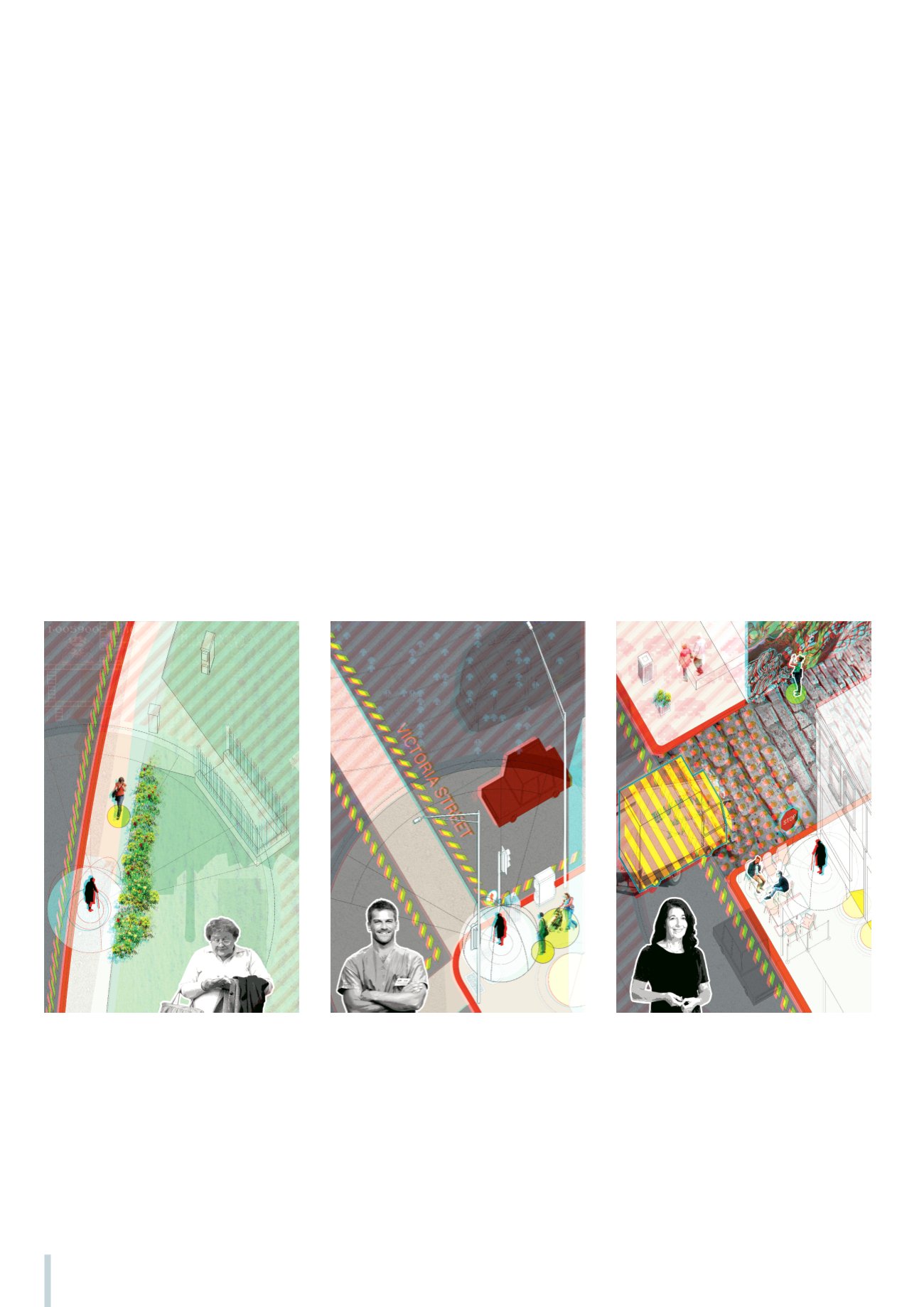
These illustrations from the author’s design project show Gladys’ journey with the assistance of the PRO-d, narrated by her care network
Moira, Gladys’ neighbour, says: “Gladys is
a terrific gardener, you know. She doesn’t
do too much of that these days, but her
dahlias are still her favourite. That’s why
she set up the glasses to show her a big lot
of virtual flowers when she goes about. It
emphasises the real flowers too. Cheers
her up, you see.”
Mark, Gladys’ community care nurse, says:
“Gladys’ PRO-d biometrics – her blood
pressure, her distance travelled – these
metrics are a really useful way for us to see
how she’s going. She’s really increased her
physical activity to a much more healthy
level as she’s gotten more familiar with the
device. Getting outdoors and keeping up
the exercise means social interaction too,
which is great for her general well-being.”
Maddie, Gladys’ daughter, says: “My
biggest worry with Mum was her going out
by herself and getting lost or having a fall.
Traffic is a bit of a concern too. But the
PRO-d glasses help her with directions and
give her plenty of warning about moving
vehicles. It really takes a lot of the risk out
of her leaving the house.”