


 27 / 40

Vol 5 No 3 June/July 2016
Australian Journal of Dementia Care
27
T
he relationship between the built
environment and dementia care
seems explicit enough to the casual
observer. Architects design new
institutional care facilities (or co-ordinate
the modification of existing ones) in a
process governed by design codes and
yield targets. Architecture’s influence
beyond the institution is scarcely
acknowledged, let alone the prospects of
urban design; indeed, expert designers
seldom attend to the homes of people
with dementia, or to the surrounding
streets. Enablement devices within the
private dwellings of older people remain
limited to the grab rail, and our
neighbourhoods are effectively devoid of
dementia-specific strategies.
The environment and well-being
But this accepted and plainly narrow
concept of the role of architecture and
urban design in dementia care
underestimates the power of our
environment in shaping our health and
well-being, and the potential for
architecture to positively influence this
environment.
In recent times, neuroscientists,
cognitive psychologists and public health
researchers have begun to measure the
effect of our surroundings on our bodies
and minds, confirming something long
known; that a connection to nature and
to community significantly improves our
physical and mental well-being (Ellard
2015; Williams 2016).
Specifically in dementia research,
social interaction and physical activity
has been linked to decreasing rates of
cognitive decline in people with
dementia (Wang
et al
2002; Zunzunegui
et
al
2003; Weuve
et al
2004). The public
realm – the world beyond our private
dwelling space – is, for many people, a
primary source of both social interaction
and physical activity.
A growing number of people living
with moderate or severe dementia are,
fortunately, able to live in dementia-
specific care homes that facilitate
residents’ social and physical
stimulation. However, an even
greater number of people with
milder forms of cognitive
difficulty are living in
private dwellings. This
cohort, living with mild
cognitive impairment
(MCI) or prodromal
(mild) dementia, may
experience symptoms
but remain
undiagnosed for an
average of three years
prior to accessing
dementia support
services and/or receiving
a definite medical diagnosis
(Phillips
et al
2011; Speechly
et al
2008).
Overcoming barriers
People with MCI or
prodromal dementia –
particularly those living in
private dwellings – must
confront many physical
and psychological barriers
when venturing out into
the public realm. Whether
based on a real or perceived risk, the
fear of getting lost or having a fall can
be a significant deterrent when
contemplating a journey to the
shop or the local park.
Given the empirical link
between well-being and our
connection to nature and
community, it follows that
overcoming barriers to
engagement with the public
realm is critical to
maintaining the quality of
life for people with dementia
who live in private
dwellings. It was this
realisation that led me to
reconsider the role of
architecture and urban
The adventures of Gladys in
(an augmented) wonderland
Jil Raleigh
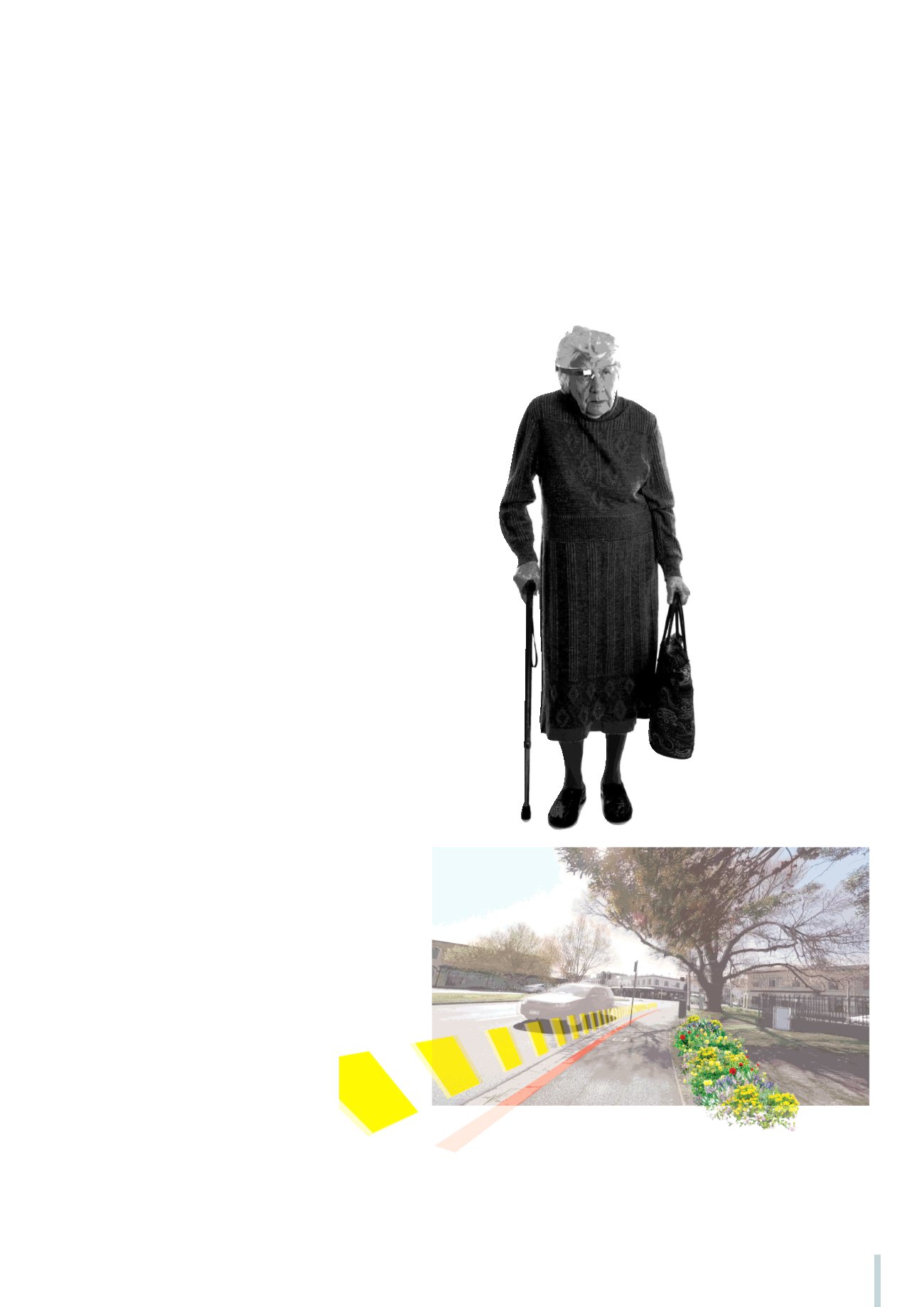
’s innovative design project uses a hypothetical scenario, featuring Gladys and her PRO-d
glasses, to explore the potential of wearable ‘smart’ devices and augmented reality to empower and
enable people with dementia to more easily access and navigate public space
This image, created by the author, depicts Gladys’ view of her neighbourhood, as ‘seen’
through the PRO-d glasses, with potential hazards and objects of interest (such as the
flower bed) emphasised
Gladys, PRO-d user, says:
“Since I started using the
glasses, it’s gotten a lot
easier to get out and about.
I’m much less worried about
losing my way now and
things are easier to understand than
before because of all the little
augmentations.”