


 24 / 40

24
Australian Journal of Dementia Care
June/July 2016 Vol 5 No 3
S
ome 80 years ago, the late great
Finnish architect Alvar Aalto said:
“Architecture cannot save the world,
but it can set a good example”.
Good architecture is more than fine art –
it is also an applied art that must suit the
physical, emotional and functional needs
of the users, while also inspiring the
human spirit. This awareness comes about
from a sharing of studies by architects,
psychologists, sociologists,
environmentalists and others.
After years of neglect or lack of
understanding, people with dementia
have finally been recognised as having
special needs that are not met within the
usual aged care facilities. Early
architectural designs inAustralia, mainly
developed since 1970, focused on issues
such as domestic character, social scale,
home-like familiarity and ‘wandering’
behaviours. Later designs explored the
benefits of multiple cueing. Aset of
research-based criteria supporting these
principles has now been identified by
Fleming
et al
(2012) to guide the design of
new facilities. Unfortunately many new
projects show little awareness of these
principles and are neglecting the chance to
develop settings that will enable residents
to use their residual abilities, and that will
also enhance the home’s dementia care
and activity programs, and the functional
aspects of the building.
Australian Government regulations up
to the early 1980s encouraged the design of
hospital-like buildings for aged care
residences. The gazetted regulations
concentrated on functional details and
equipment, making no reference to quality
of life issues. The terminology and
references were all medical. Dementia was
not addressed. People with dementia were
classed as mental patients and confined in
the feared and isolated asylums. These
replicated the international pattern of
being large and forbidding institutions
segregated from the community and
usually located outside the city limits.
Teaching programs
In 2012, as part of the NSW/ACT
Dementia Training Study Centre’s
undergraduate education focus, I was
asked to develop a course on ‘Designing
for Dementia’ for architectural design
students. The intention was to increase the
pool of empathetic designers aware of the
issues and relevant research on design for
people with dementia. It would build on
the research outcomes and the evidence
base already available, and on my
extensive experiences as an academic and
practitioner in aged care design.
The aimwas to develop a model
program for teaching architectural
students the issues involved in designing
for people with dementia, to base their
designs on research-based evidence, and
hopefully to produce new thinking. I have
been conducting the courses at the
University of Melbourne (2012 to 2015)
and Deakin University (2012) using the
following sessions to awaken an
awareness in students of the existing
knowledge and opportunities for its
application :
• The history of aged care design.
• The evolution of the design of buildings
for people with dementia and other
cognitive impairments.
• Anon-medical approach to building
design.
• Presentations by key professionals in the
field, including representatives of
Alzheimer’s Australia Vic, carers,
administrators, researchers and
experienced architectural practitioners.
• Site visits to some contemporary aged
care facilities.
• Research into established principles and
contemporary developments in
dementia design.
Valuable input was provided by
recognised dementia specialists and
architectural practitioners in the field. The
Designs on the future
Traditional and current solutions to dementia design are unlikely to be palatable to future
generations, says
Brian Kidd
. He reports on a successful teaching program for
architecture students aimed at increasing the pool of empathetic and dementia-aware
designers able to create innovative environments in the years ahead
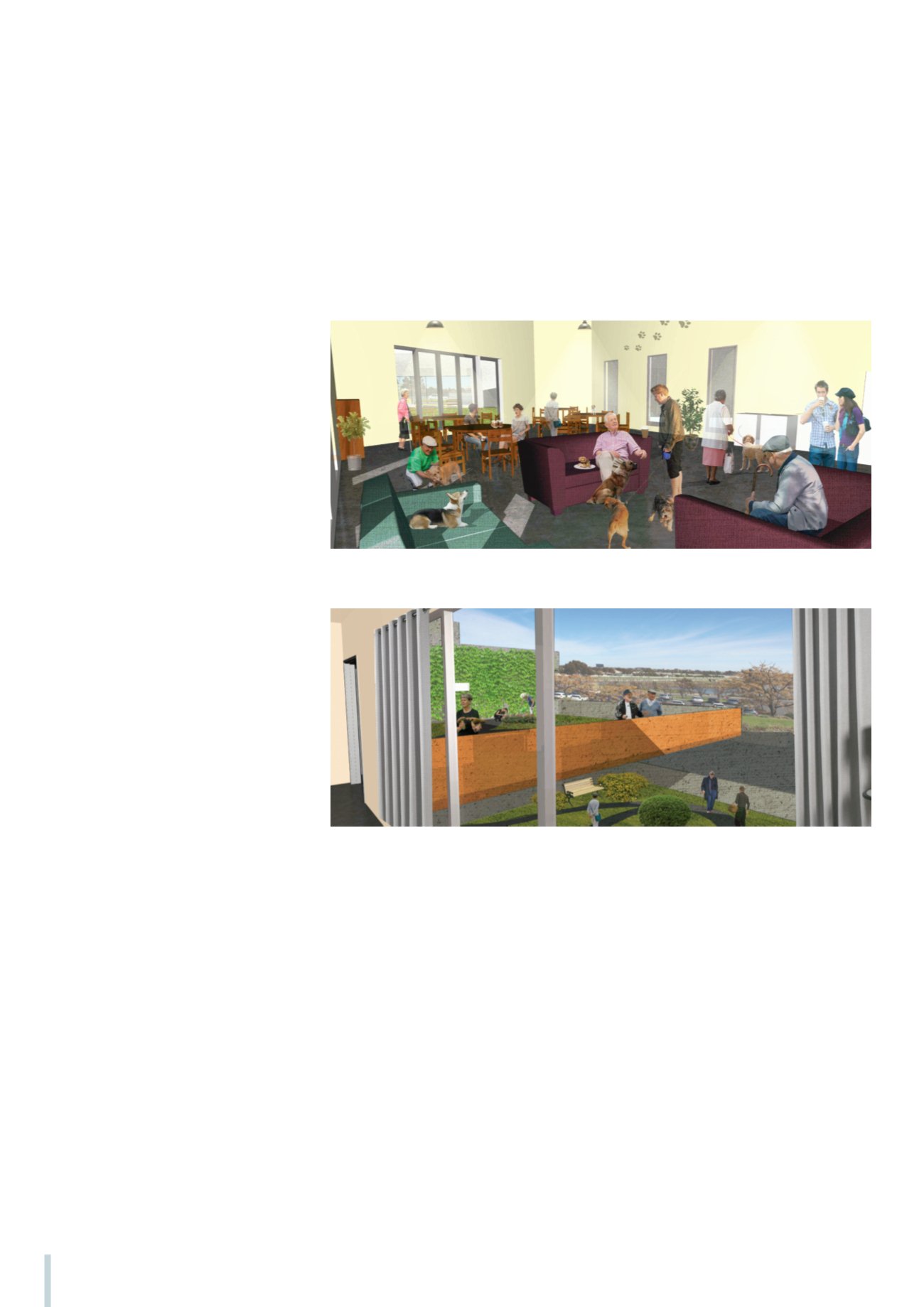
Architecture student Queenie Chiu’s dementia-friendly building design proposed some
interesting ideas for community involvement, including a pet café (above). The drawing
below shows a view to the garden