


 20 / 40

20
Australian Journal of Dementia Care
June/July 2016 Vol 5 No 3
in, or to be with others.
Anton Pieckhofje gives residents easy
access to the outdoors in a secure setting
but is very much a part of the
neighbourhood, a place for ordinary life to
go on where people can pursue their
interests, keep their pets and be
themselves.
Part of the community
At Bergweg, Rotterdam, the focus too was
on residents living a fulfilling life, being
part of the community, and connecting
with others through contact with nature
and life. The first of the Humanitas
Apartments for Life, built in 1996, it was
striking to see Bergweg’s apartments
facing the main street with trams running
by, a supermarket below and the
Desiderus restaurant in the central light-
filled atrium.
The Apartments for Life reflect the
cultural and social makeup of the wider
community, with day programs catering
specifically for people from Suriname, the
Netherlands, Morocco and the gay
community. The atrium is a gathering
space for everyone: apartment owners,
day centre participants, locals and visitors.
On the day I was there it was a place to use
the internet, buy some second-hand
clothes, play pool, collect mail, buy fresh
fish to cook, or have a meal or cuppa. A
place filled with life and possibilities.
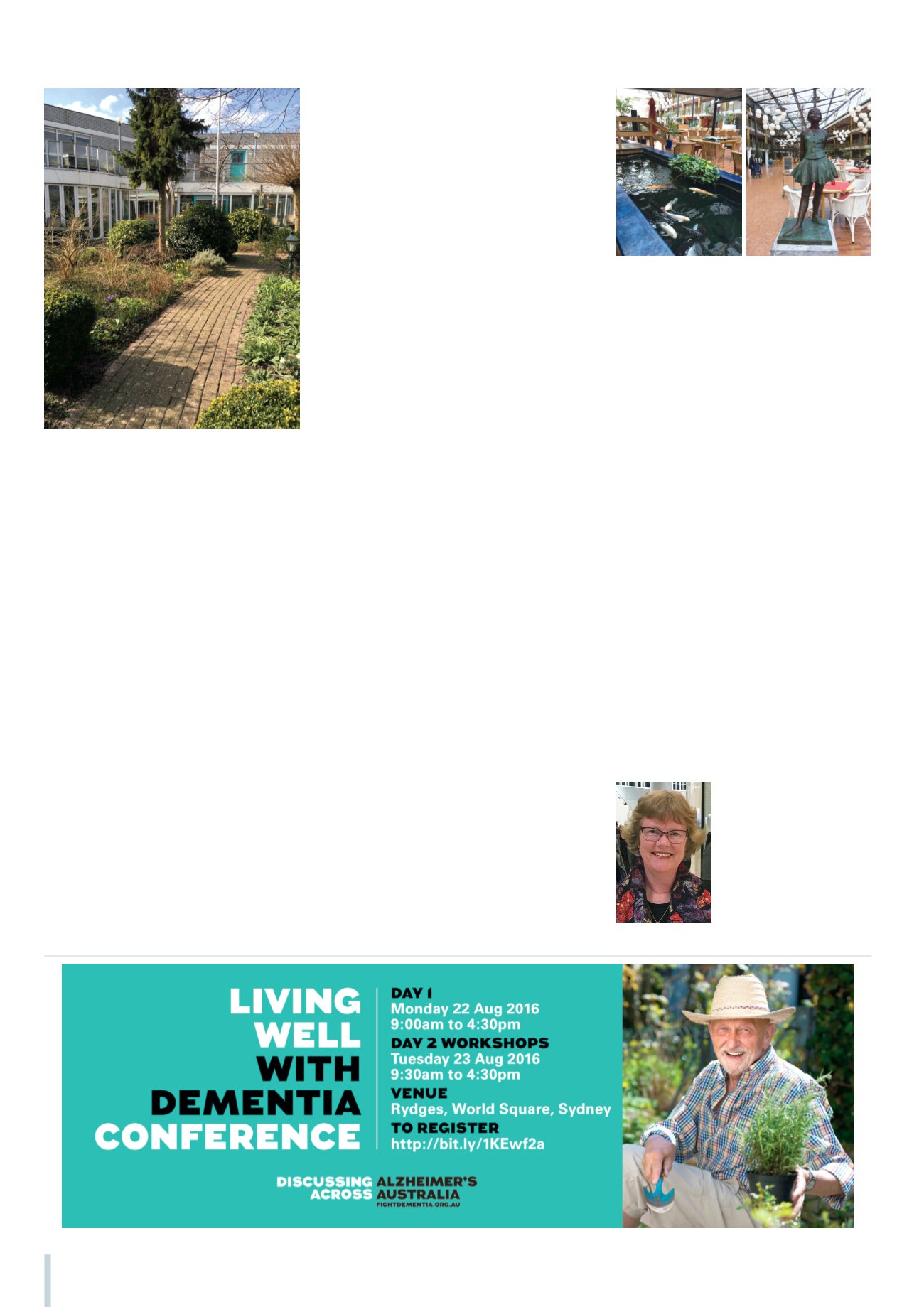
There were carp swimming in the pond
and art pieces everywhere to prompt
conversations and stimulate memories
and connections: when I saw a replica of
Degas’
Little Dancer
statue in the atrium I
was taken back to Washington, to Paris, to
Copenhagen where I have also seen her,
and to my dear friend Ted who had first
told me about her.
Clear vision
While visiting these three places in the
Netherlands I was struck by the richness
of the life that they offered residents and
the different opportunities that were
available. Two of the homes were
approximately 20 years old in established
neighbourhoods and one was new and in
a developing housing area. All were of
varying scales and home to different
numbers of residents. They were multi-
storey, two-storey and single storey; two
were in suburban settings, and one was
more urban; all connected with the
outdoors and sought to provide a sense of
community. Each had a clear vision of
what makes a great day – and that vision
was not focused on the care, the routine,
the regulations, the difficulties, but on
living life.
There are so many ways that we in
Australia can do this too and there are
examples here that can inspire us.*
Let’s be inspired
InAustralia we live in such diverse
communities with so many different
cultural backgrounds, as well as different
climates. We bring so many varied life
experiences, with our urban, suburban
and country lifestyles. We have great
weather that offers us incredible
opportunities to spend time outside.
Perhaps we can dream again, and try
not to be weighed down by what the
limitations and problems might be, but
rather be inspired by the possibilities.
Maybe we can adopt Humanitas’
approach of answering ‘yes’, and then
figuring out what is the reasonable
solution to make it possible.
Let’s articulate a vision for aged and
dementia care that is about life and living.
Then we may answer with confidence that
‘yes, this will be a great day’.
* For more information about environmental
design for people with dementia contact the
NSW/ACT Dementia Training Study Centre’s
(DTSC) Environmental Design Education
Services on (02) 4221 5927 or email
dementia@uow.edu.au. The service is
offered to aged and health care services in
Australia and provides education on how the
built environment can be used to maximise
the quality of life of people with dementia
and to minimise behavioural expressions of
need.
Kirsty Bennett is an
architect and Manager of
the NSW/ACT
Dementia Training
Study Centre
Environmental Design
Education Services.
Contact her at:
kbennett@uow.edu.au.
The courtyard garden at Anton Pieckhofje
apartments
Carp in the pond and a replica of Degas’
statue,
Little Dancer,
in the atrium at
Humanitas Apartments for Life, Bergweg,
Rotterdam