


 26 / 40

The other Malaysian student proposed a
scheme at the opposite end of the socio-
economic scale, keeping residents close to
their familiar neighbourhood in downtown
Kuala Lumpur. The three-storey building
provided facilities needed by the local
community, including a public library, a
child care centre, counselling and
educational services, a convenience store,
cafes and restaurants, all on the ground
floor. The upper floors created a residential
environment that allowed people with
dementia to remain in their familiar
territory, near family support. The first
floor accommodated 48 people with
dementia. Clusters of four bedrooms were
grouped around a small social lounge, and
clusters of eight bedrooms shared a larger
social space/dining area. Each area was
given its own identity through the use of
colour, local materials and familiar objects.
The upper floor provided respite
accommodation for 36 people.
In 2014, a third student explored the
issue of a family residence suitable for a
person with dementia. She selected a real
project – in this case for her parents and
grandparents – on a small site in inner
suburban Camberwell inMelbourne. The
student’s design comprised a fully self-
contained residence for her parents on the
ground floor, with two self-contained units
on the upper floor. One upper unit was for
private sale or rental, to finance the costs of
a live-in carer who would occupy the other
unit.
In 2015 the course was offered to
students undertaking the Design Thesis
elective as their final project. This is the
final andmajor design subject for the
degree of Master of Architecture at The
University of Melbourne, and is the
appropriate course as this topic involves
considerable research and extensive
investigation, requires a written thesis, and
then a commitment to a specific solution
designed to improve life for a specific
group. These students all came with some
personal family experience of dementia
and its challenges.
The international project that attracted
most interest from the students’ research
was De Hogeweyk in the Netherlands.
This is a residential project for 161 people
with dementia, accommodated in 23
separate houses, each for seven people. The
site is within a densely populated suburb
and contains a supermarket, restaurant,
theatre, and some meeting rooms, all also
used by members of the local community.
The students were greatly impressed by
the location within a residential
community and the community outreach,
usage, involvement and acceptance. The
principles of this scheme were reflected in
the student designs.
All students selected extremely
interesting sites in densely populated inner
suburbs of Melbourne or in the centre of
busy overseas cities. All the designs offered
services and involvement to the local
community.
One student designed a scheme which
included a small movie theatre (to
encourage reminiscence and revive happy
memories), plus a small art gallery, a pet
café and a small indoor bowling alley for
use by the local community. Another
designed residential facilities, day care and
educational services on top of a shopping
centre in Collingwood, and another a
scheme near a park in Brunswick adjacent
to a busy shopping precinct and including
a child care centre. Both were designed to
be available to and involved with the local
community.
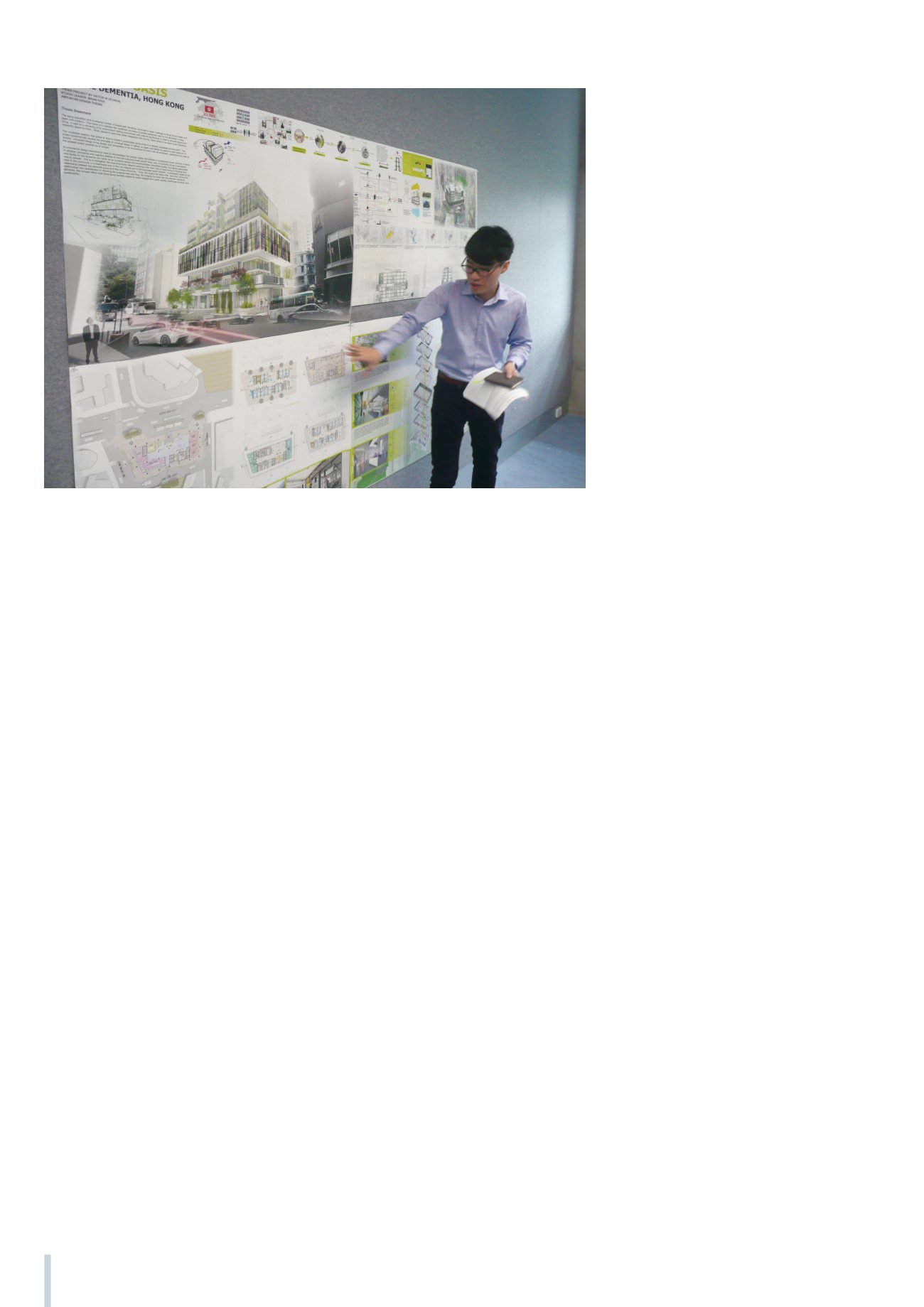
One student designed a project set in the
centre of busy Hong Kong, and another in
Penang, both involving residential care and
services and programs available to the
whole community. The Penang scheme
used a small attic space above the
resident’s bedroom as temporary space for
a relative for overnight stays.
One student used her design skills in a
different way, electing to investigate a
device to assist a person in the early stages
of dementia to navigate their local
community shopping area and urban
environment. (See the article by Jil Raleigh
on p27 of this issue for a description of this
project).
Conclusion
The challenge of designing for people with
dementia is assuming greater importance
with the coming of age of the baby boomer
generation. Traditional and current
solutions are not likely to be palatable to
future generations. New creative models
based on empathy, awareness of research
data and innovative thinking are required.
The design studios described here have
demonstrated that students are able to
make innovative responses to this design
challenge, with solutions involving
residential care homes, community
housing, individual private housing,
educational and counselling services, and
the inclusion of the local community.
It is hoped that other universities will
take up the challenge and introduce similar
teaching programs as an integral and
socially responsible component of design
teaching.
With any dementia design solution, the
key aim is to respect the dignity of the
individual, enable them to function to the
best of their residual abilities, and to
nourish their souls and lift the spirits of the
person with dementia, and also families,
friends and support carers.
References
Fleming R, Fay R, Robinson A (2012) Evidence-
based facilities design in health care: a study of
aged care facilities in Australia
. Health Services
Management Research
25(3)121-128.
Fleming R (2011) An environmental audit tool
suitable for use in homelike facilities for people
with dementia
. Australasian Journal on Ageing
30(3) 108-112.
Brian Kidd AM (MArch, LFRAIA, Dip
TRP, ACAA) is a Senior Fellow at The
University of Melbourne. Contact him at:
briankidd36@bigpond.com26
Australian Journal of Dementia Care
June/July 2016 Vol 5 No 3
Student Victor Ip with his designs for a wellness centre in Wan Chai, Hong Kong