


 35 / 64

Quality Training
Volume 12 No 2
I
March 2016
35
Undertaking an overseas fellowship
at the completion of my training
was one of my goals throughout my
radiology training. As a radiology
registrar, the biggest initial challenge
in preparing for a fellowship in the
United States was studying to pass the
United States Medical Licensing Exams
(USMLE) in order to secure a licence to
practise there. Somehow I managed
to remember enough biochemistry,
physiology and pharmacology to
pass the written exams, borrowed a
stethoscope from a friend for the clinical
exam, and with a bit of a revision, acted
like I knew exactly what I was doing
examining the chest and abdomen of a
standardised patient for the first time in
five years.
With my license in hand and our three
young children packed up and ready,
we made the move to New York City
to begin my fellowship in oncologic
imaging at Memorial Sloan-Kettering
Cancer Center (MSKCC).
MSKCC is ranked among the top
cancer hospitals in the USA, serving a
population in excess of 20 million in
the tri-state area, as well as receiving
many referrals for patients across the
US and internationally. Situated on
the Upper East Side of Manhattan, it
is conveniently located to many of the
attractions of New York City (NYC).
Living only a few blocks away from the
hospital in one of the many high-rise
apartment buildings in the area allowed
us to adopt a change in lifestyle and
truly experience life in NYC.
The oncologic imaging fellowship
provides extensive experience in body
imaging using various modalities
but with a particular focus on
magnetic resonance imaging (MRI).
In combination with the large patient
population, there is never a shortage of
work to be done and experience to be
gained.
One of the attractions of the fellowship
was the opportunity to see and report
a large volume of sometimes complex
body imaging cases, particularly in
MRI, over a relatively short period of
time, thereby gaining the necessary
experience and expertise to lay a
foundation for future practice as a
body imaging radiologist upon my
return to Australia. I have had the
opportunity to work with and learn from
radiologists who are expert in their
field, who are well-regarded researchers
and publishers in the radiology and
oncology literature, and who are sought-
after international speakers on these
topics.
Other opportunities have included
participation in research projects,
including pre-operative prostate MRI
and pancreatic MRI screening in BRCA
patients, participation in disease
management team meetings, and
experiencing the US healthcare system
as a whole. Working together with 17
other fellows in the body and breast
imaging programs has been a privilege
and afforded the opportunity to develop
friendships which will last long after the
fellowship is over.
A fellowship at the completion of
training as a registrar—either interstate
or overseas—is an ideal opportunity to
develop new skills, subspecialise in an
area of interest, experience a different
environment and way of doing things,
learn from distinguished radiologists
in the field, and form professional
relationships that will last throughout
one’s career. For our family, it has been
an adventure that has created memories
we will remember for the rest of our
lives.
The fellowship ends in July this year
when we will return to Adelaide and I
will continue my career in Australia.
Dr Mitchell Raeside
Oncologic Imaging
Fellowship in the US
An overseas fellowship following completion of his training
was the ideal opportunity for Dr Mitchell Raeside
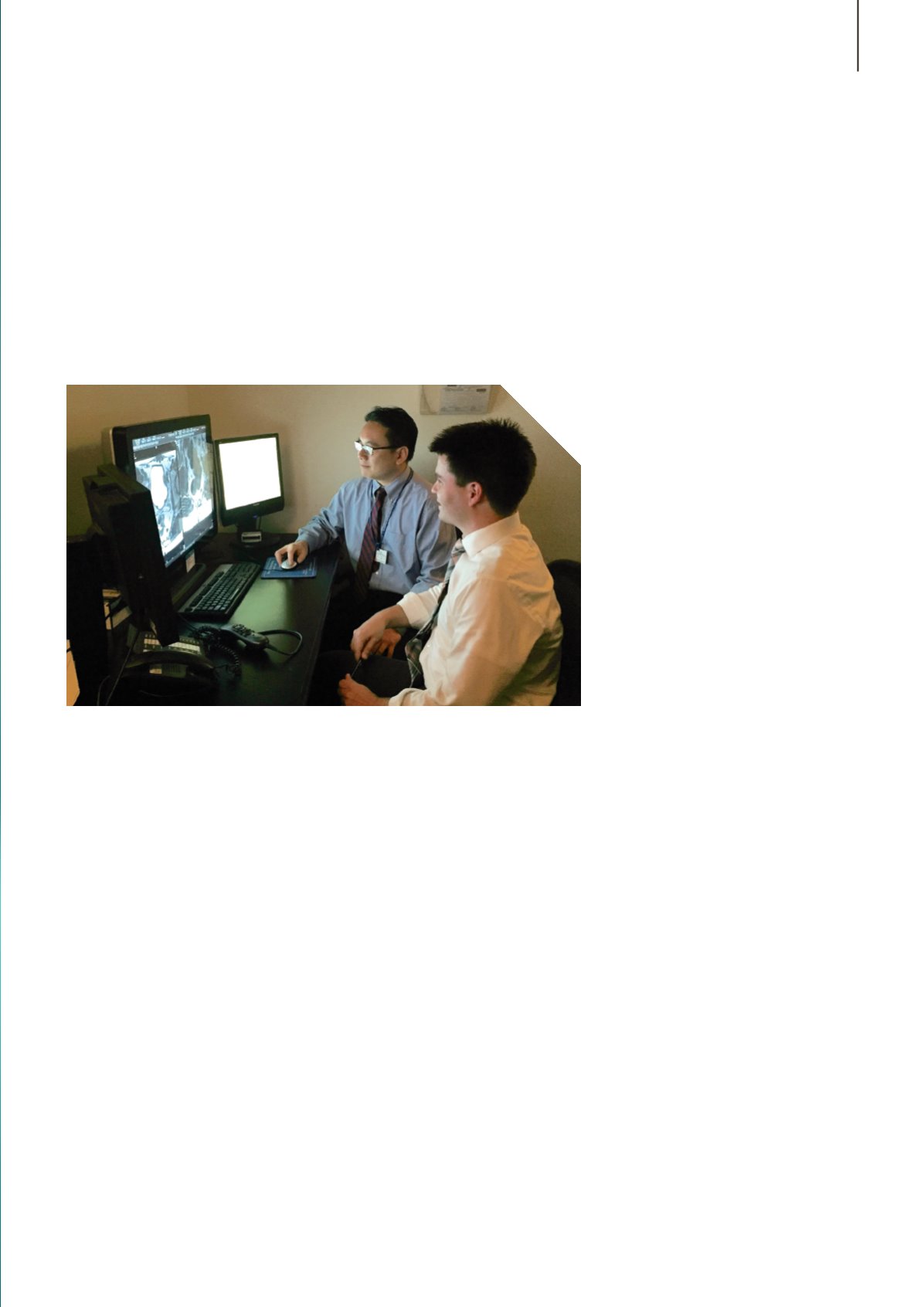
Dr Mitchell Raeside with Dr Richard
Do, Radiologist (Hepatobiliary)