


 67 / 68

New resource for remote Aboriginal communities
A new culturally appropriate resource is now available for
professionals and health workers supporting people with
dementia in Aboriginal communities in remote areas of Australia.
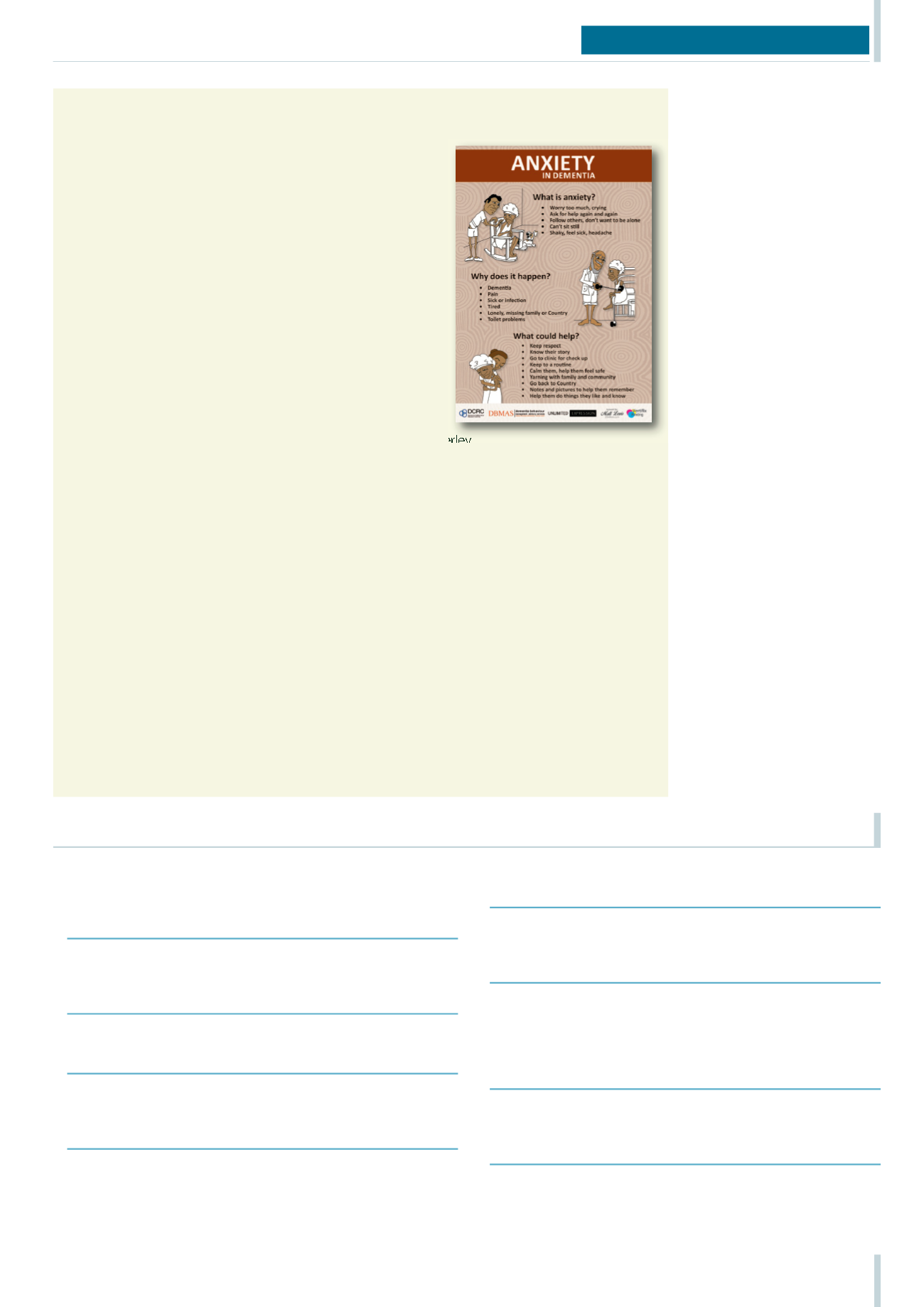
The set of 11 posters is designed to aid communication around
dementia and behavioural and psychological symptoms of
dementia (BPSD).
The posters include information and strategies to assist with
reducing the problems associated with aggression, agitation,
anxiety, apathy, calling out, delusions and hallucinations,
depression, resistance to care, sleep problems, socially
inappropriate behaviours and wandering.
They have been developed by the Dementia Collaborative
Research Centre: Assessment and Better Care (DCRC: ABC), in
collaboration with the Dementia Behaviour Management Advisory
Service, Northern Territory (DBMAS NT) as well as other clinicians
from Alzheimer’s Australia, Aged Care Assessment Teams and
the acute sector working in the Northern Territory and the Kimberley.
The posters are based on the principles outlined in the document
Behaviour Management – A Guide
To Good Practice: Managing Behavioural And Psychological Symptoms Of Dementia (BPSD),
which
was produced in 2012 by the DCRC: ABC to support those caring for people living with dementia
with BPSD. The
Guide
includes additional considerations for managing BPSD when working with
Aboriginal and/or Torres Strait Islander people with dementia.
The poster project was prompted by clinicians visiting Aboriginal communities in remote areas who
wanted a resource that supported their use of the DBMAS BPSD videos (available at
http://dbmas.org.au/resources/videos/), and which could be left in the community after the visit. The
video project included an Indigenous consultancy group to ensure the content was culturally
appropriate and acceptable.
The BPSD posters are available in hard copy, A3 colour format by request (email
k.burns@unsw.edu.au), or as PDFs which can be downloaded from the resource page on the DCRCs’
new DementiaKT Hub website at
http://dementiakt.com.au/resource/bpsdposters-aboriginal/.The posters were specifically developed to support Aboriginal communities living in
remote areas of Australia. Health professionals are advised to use their clinical judgment
in determining whether the resource is appropriate for use with people from Aboriginal
communities living outside remote areas.
R E S O U R C E S / E V E N T S
Vol 5 No 5 October/November 2016
Australian Journal of Dementia Care
67
5-6 October – VIC
Strengthening Dementia Services Conference
Supported by COTA and Alzheimer’s Australia, in Melbourne. Details:
https://www.criterionconferences.com/event/sds/7-8 October – NSW
Navigating an Inspired Future
Presented by Diversional Therapy Australia, in Sydney. Details:
http://diversionaltherapy.org.au/.9-12 October – QLD
LASA National Congress 2016
Presented by LASA, on the Gold Coast. Details:
www.lasacongress.asn.au/13 October-11 November – National
Better Practice 2016: The Quality Experience – Beyond the Expected
Presented by The Australian Aged Care Quality Agency. Perth 13-14
October; Brisbane 10-11 November. Details:
http://bit.ly/24NIGie.25-27 October – NSW
2nd Annual Dementia Strategy Summit
Three-day summit and ‘meeting of like-minds’ presented by Akolade, in
Sydney. Discuss delivering best practice care for people living with dementia
and preparing for scalable growth in an era of reform. Details:
https://akolade.com.au/events/annual_dementia_strategy_summit/26 October – SA
Forward Thinking: innovatively working with people with dementia
Presented by Occupational Therapy Australia, in Adelaide. Details:
http://bit.ly/29QIj1p23-24 February 2017 – SA
8th Annual National Dementia Conference
Presented by Informa, in Adelaide. Send topic and speaker submissions to
Lisa.Hedlund@informa.com.au. Early bird registrations available before 28
October. Details:
http://www.informa.com.au/conferences/health-care-conference/national-dementia-conference
26-29 April 2017 – Japan
32nd International Conference of Alzheimer’s Disease International
In Kyoto. Online registration and abstract submission now open. Details:
http://www.adi2017.org/17-20 October 2017 – VIC
Alzheimer’s Australia National Conference 2017
In Melbourne. Details:
http://bit.ly/29wp4IQEvents
Dementia evidence toolkit
is
the first of its kind in the world –
a comprehensive free web tool
providing easy access to
research evidence on dementia
care and treatment. Launched
in August, it brings together
more than 3000 empirical
journal articles and 700
systematic reviews (published
from January 2009 to 30 June
2015), each coded according
to the type of dementia, care
setting, outcome measured,
type of intervention and country
of study or authors.
It has a searchable database
and provides plain-language
summaries of research findings
for care and treatment
interventions and a rating for
each. The summaries look at:
why is the intervention
important, does it work, how
strong is the evidence, how
much does it cost and is it
cost-effective. It also indicates
which interventions require
further research.
The toolkit was developed by
researchers at The London
School of Economics and
Political Science’s Personal
Social Services Research Unit
as part of the MODEM
(Modelling the Outcome and
Cost Impacts of Interventions
for Dementia) project.
It can be accessed freely
at
http://toolkit.modem- dementia.org.uk/.