


 57 / 68

Vol 5 No 5 October/November 2016
Australian Journal of Dementia Care
57
“He just has to walk, he never stops - it’s like
he’s compelled or something.”
T
hese words were shared with our
research team by the wife of a person
with dementia who wanders*. Her
words planted the seed for an idea that
blossomed into a pilot programdesigned
to promote healthy walking, while
reducing risky aspects of wandering in
people with dementia living in residential
aged care (RAC).
In scientific literature dementia-related
wandering is defined as persistent walking
that appears to have no purpose or
outcome, that occurs day and night, and
that can result in the person becoming lost
unless accompanied (Algase
et al
2007).
Wandering-related BT
Our earlier research described the
characteristics of wandering-related
boundary transgression (BT) – that part of
dementia-related wandering that takes the
person into out-of-bounds or hazardous
areas (Moore
et al
2009). Building on that
work, we have recently developed and
trialled a supervised walking program for
people with dementia in RACwho
wander.
Care staff and family members had
previously told us that wandering-related
BT, or intrusion as it has historically been
referred to, is a common behavioural
symptom of dementia that most frequently
results in the person with dementia
entering the private or restricted spaces of
others, often resulting in loss of privacy
(MacAndrew
et al
2015). This aspect of
wandering was also very worrying to staff
and families because they could not predict
when a BT would occur and if the resulting
intrusion would cause distress to others.
Consequently, managing BT equated to
responding only to a BT that was
disturbing to others rather than proactively
trying to prevent it from happening.
Our 2014 observational study of BT
identified a number of negative outcomes
of BT when participants entered the private
space of other residents who were present
at the time. Negative outcomes included
social isolation of the resident prone to BT,
injury from resident-to-resident
altercations instigated by the person whose
private space was entered without
permission, and increased anxiety for other
residents.
These findings supported development
of more effective methods of responding to
BT in residential aged care (MacAndrew
2014).
Responding more effectively
After consulting with professional and
family carers of people with dementia who
wander, as well as people with dementia
who wander, we collated a list of possible
approaches to responding more effectively
to wandering behaviour. At the top of the
list was the suggestion that going for a
walk with the person may help. Based on
this feedback and what is known about the
characteristics of wandering and BT
(MacAndrew
et al
2016), we developed the
Walking program to reduce risky aspects of
wandering.
The walking program trial
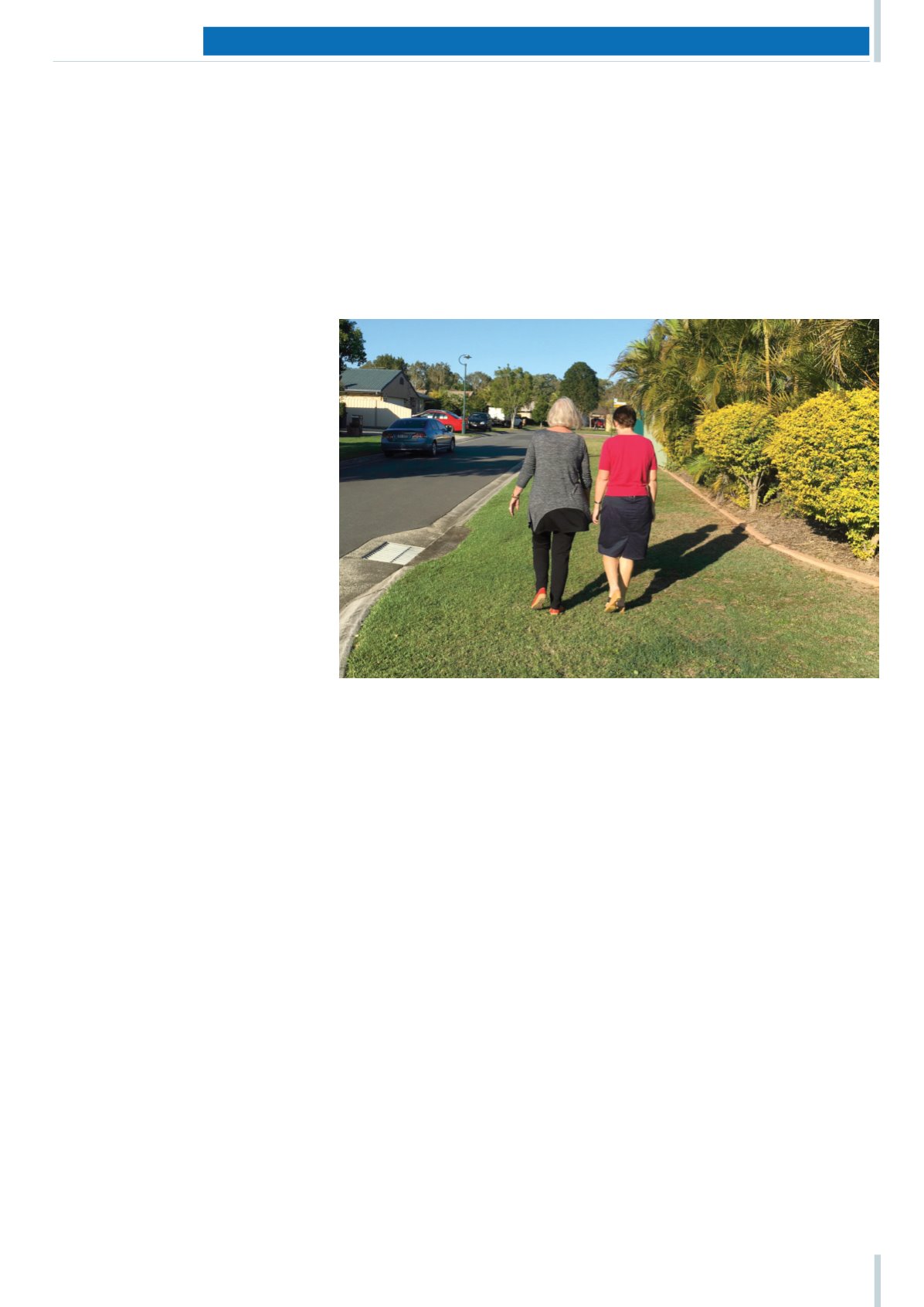
The walking program involves staff
escorting residents who wander on a 30-
minute supervised walk, five days a week,
at a time that has been individually tailored
to each person’s unique patterns and
rhythms of walking, including periods of
peak activity. Significantly, the walks occur
outside the care home perimeter – to a park
or other natural areas in close proximity –
and include a brief rest stop for a
refreshment.
The pilot study started in October 2015
and we completed the program inMay this
year. Seven residents living in two large
aged care facilities in Brisbane participated.
At this time we can report on staff
perceptions of the program’s effectiveness
and feasibility, with our main results
expected early next year.
Did it work?
We interviewed eight staff from the first
facility at the end of the program (n=1
registered nurse; n=5 personal carers; n=2
activity officers). Their feedback was
predominantly very positive. Care staff
reported that, during the program:
Participants seemed to be happier and
communicatedmore with staff.
Activities of daily living that previously
were difficult to complete with some
participants became easier and participants
seemed to needmore sleep.
Comments from staff included:
“His [the participant’s] personality came out
and he was much more vibrant. He smiled more
DCRC SPEC I AL I SSUE : THE B I G P I CTURE I N DEMENT I A RESEARCH
Taking steps to reduce
risky aspects of wandering
Margaret MacAndrew
,
Elizabeth Beattie
,
Elaine Fielding
and
Catherine Wyles
present the views
of care staff on the effectiveness and feasibility of a new walking program for people with dementia