



 25 / 64

Quality Practice
Volume 12 No 2
I
March 2016
25
New Zealand have criteria based on
“Risk of harm” and “Risk of serious
harm”” indicated respectively by
Risk of harm
• a pattern of practice over a period
of time that suggests the doctor’s
practice of medicine may not meet
the required standard of competence;
or
• a single incident that demonstrates a
significant departure from accepted
standards of medical practice; or
• recognised poor performance where
local interventions have failed - this
does not exclude notification of
serious concerns where internal
review or audit is inaccessible or
unavailable to the person with the
concern; or criminal offending; or
• professional isolation with declining
standards that become apparent.
Risk of serious harm may be indicated
when:
• an individual patient may be seriously
harmed by the doctor; or
• the doctor may pose a continued
threat to more than one patient
and as such the harm is collectively
considered ‘serious’; or
• there is sufficient evidence to suggest
that the alleged criminal offending is
of such a nature that the doctor poses
a risk of serious harm to one or more
members of the public.
Practitioners, in either country, who file
frivolous reports for the purposes of
mischief may also be subject to conduct
action.
Practitioners are urged to keep up to
date with the current requirements by
reviewing the information provided via
these links.
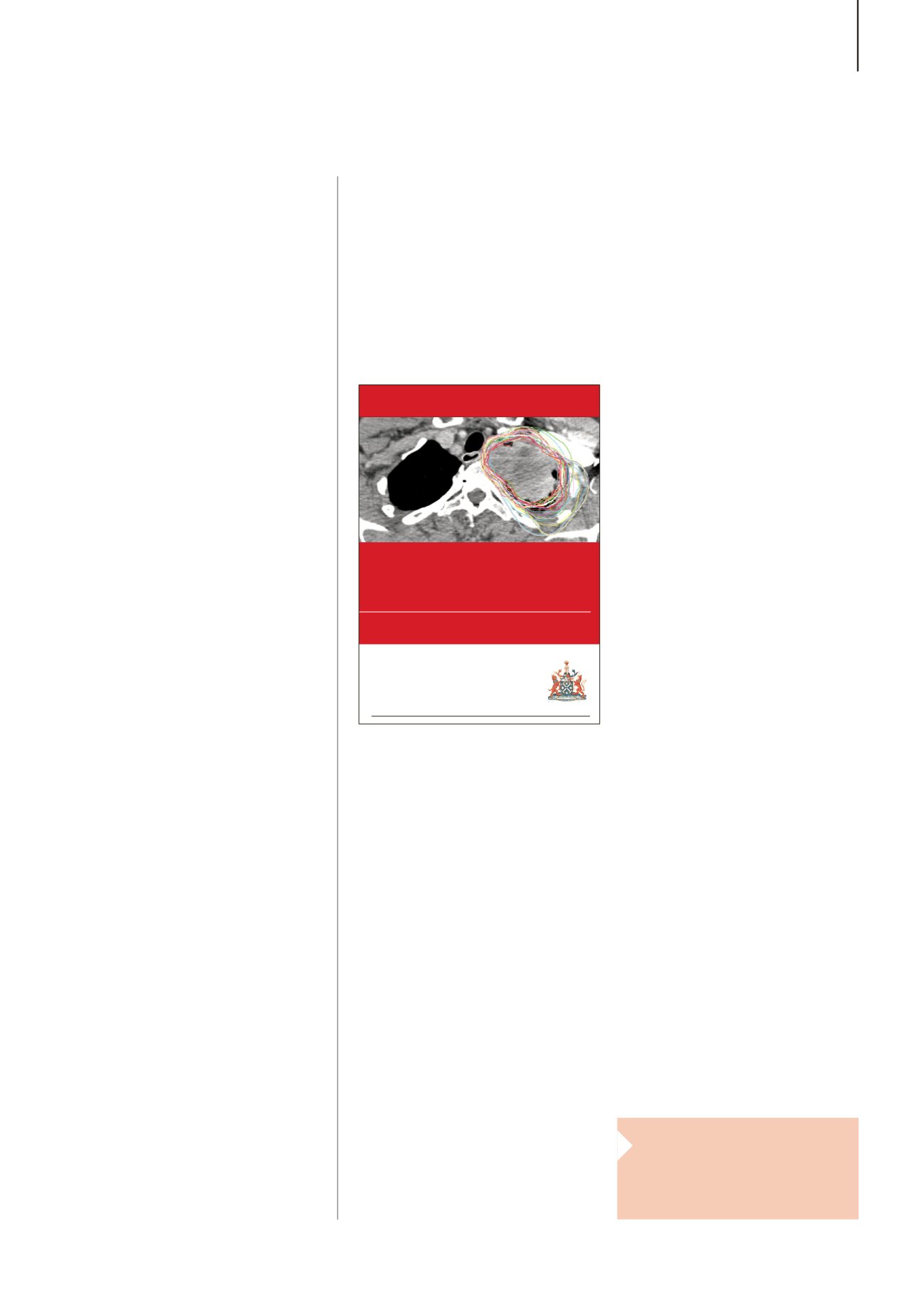
Quality Guidelines for
Volume Delineation in
Radiation Oncology
Modern technology allows radiation
therapy to be delivered with
increased accuracy. However, target
delineation—a complex process
involving multiple factors such as
patient history, tumour pathology,
known disease patterns, imaging
modalities available and individual
experience—is, by its very nature
less accurate.
Inaccuracies in target delineation can
lead to a geographical miss of the
tumour or increased dose to important
organs at risk (OAR) resulting in poorer
tumour control or increased toxicity.
Finding agreement on the ‘true’
target volume is seldom possible even
among experts. Minimising variation
among radiation oncologists is an
important goal to allow the delivery of
quality treatment.
The Quality Improvement Committee
of the Faculty of Radiation Oncology
(FRO) assembled a group of radiation
oncologists to produce guidelines for
volume delineation.
This group was led by A/Prof Shalini
Vinod. One of the challenges was to
produce a document that would be
useful for the whole target audience—
from subspecialists at larger
institutions, to generalists at smaller
centres, and to trainees.
There was a strong emphasis on
championing ongoing education,
developing local contouring protocols,
optimising the use of diagnostic
imaging, and establishing mechanisms
for volume review (including by
radiologists).
Although there can be no one-size-
fits-all solution, it is hoped that the
stepwise approach of the guidelines
will allow institutions and individuals to
come up with an approach that suits
their own environment.
An important part of the document
is a table listing accessible site
specific tumour and OAR atlases and
contouring guidelines. The purpose
was not to endorse any specific
publication but to allow a framework
for the development of local protocols.
To access a copy of the guidelines, visit
the College website
www.ranzcr.edu.au/resources/professionaldocuments/
guidelines
Dr Gerard Adams
Consultant Radiation Oncologist
Radiation Oncology Centres
Bundaberg
If you have any questions about
the guidelines, please contact the
Faculty of Radiation Oncology on
faculty@ranzcr.edu.auFACULTY OF RADIATION ONCOLOGY
THEROYALAUSTRALIANANDNEWZEALANDCOLLEGEOFRADIOLOGISTS
®
QUALITY GUIDELINES FOR VOLUME
DELINEATION IN RADIATION ONCOLOGY