


 30 / 68

30
Inside News
Access to Quality Services
The purpose of the RANZCR Annual
International Development Fund is
to provide small grants for overseas
development work undertaken by College
members or College groups that will
improve patient care and raise the
standard of practice in both disciplines.
As reported in Inside News in September
2015, two grants were awarded last year to
a total value of $30,956. One of the grants
assisted in funding a visit to Sydney by Dr
Kaung Myat Shwe, a mid-career radiation
oncologist from Myanmar. The other grant
enabled the running of contrast-enhanced
ultrasound workshops in Sri Lanka. Grant
applications close in March each year.
For further information visit the College
website:
www.ranzcr.edu.au/members/international
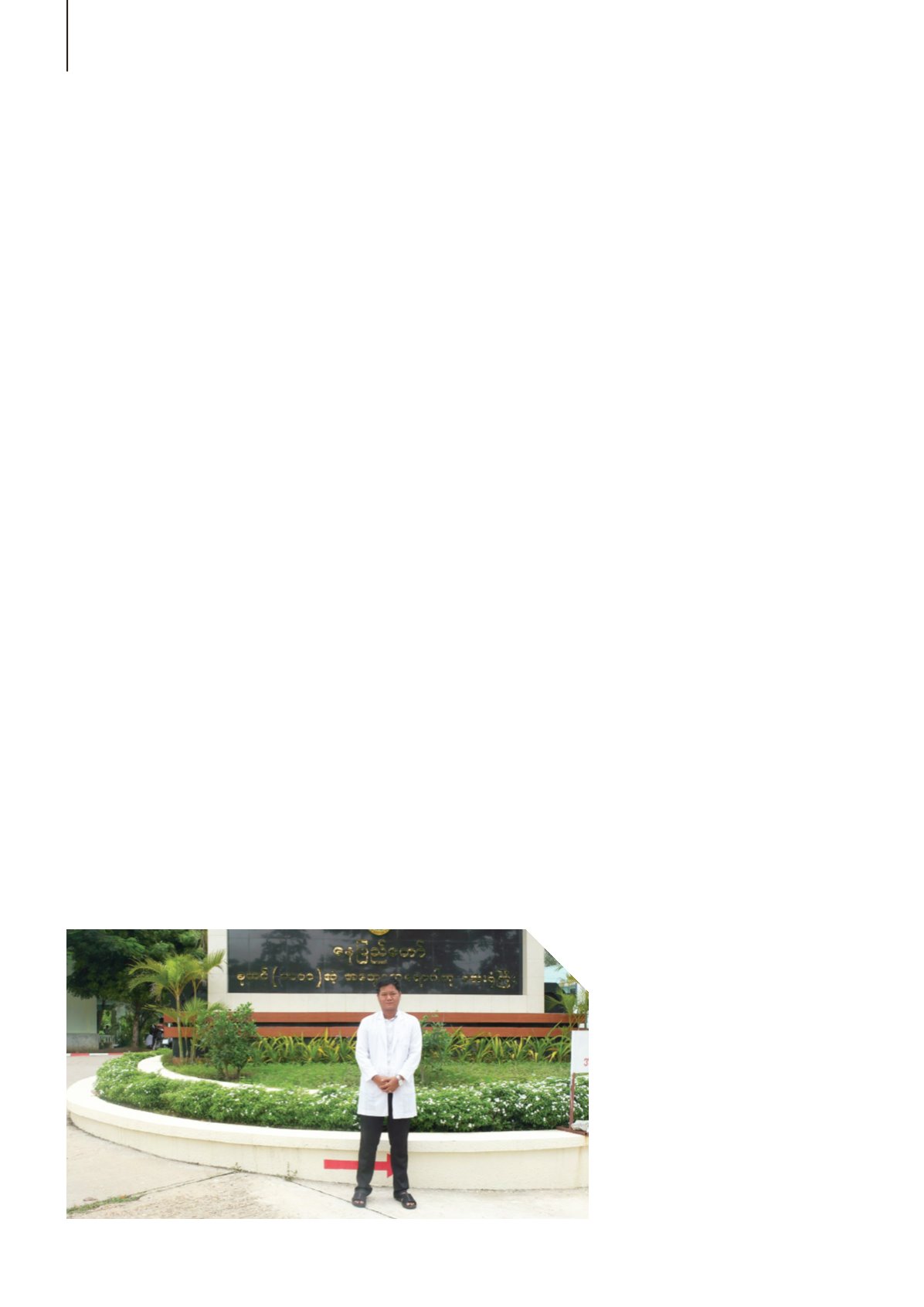
Visit by Dr Kaung
Myat Shwe from
Myanmar
According to a nationwide census in
2014, Myanmar has a total population of
51.4 million and GLOBOCAN estimated
that there were 63,600 new cancer cases
in 2012. As there is no population based
cancer registry system in Myanmar there
is no data for incidence and mortality of
the whole country so far. But according
to the hospital based cancer registry of
Nay Pyi Taw General Hospital, the most
common cancers in males are lung, oral
cavity, liver, stomach and colorectal. In
females, the most common cancers are
breast, cervix, lung, ovary and stomach.
Currently we have eight radiotherapy
centres for the whole country including
four public, two private and two military
centres.
In Myanmar, there have been changes
recently in every sector of the country
such as politics, economics and
health care, including radiotherapy.
Major refurbishments of radiotherapy
equipment include installation of new
linear accelerators, CT simulators,
immobilisation devices, dosimetry
tools and HDR Brachytherapy systems.
Therefore, we need more knowledge
and best practice of radiotherapy
treatment techniques for the treatment
facilities we have, and in this transition
period, we need help from developed
countries like Australia where we can
learn new radiotherapy techniques.
It was my great pleasure and I was
very fortunate to have six weeks
training in Australia including one
week at the Australian Brachytherapy
Conference and another week at the
Cancer Institute, NSW. This visit is part
of an ongoing engagement of the
University of Sydney’s medical school
with Myanmar and was possible with
the financial support from The Royal
Australian and New Zealand College of
Radiologists.
During the first week of my visit in
Australia, I attended the annual
Australian Brachytherapy Group (ABG)
scientific meeting in Perth. The topics
discussed in this meeting were about
advanced brachytherapy techniques
and I had the chance to expand and
update my knowledge of brachytherapy
practices, research and technology. I
also met and had discussions with other
international speakers and it was a very
good chance for me to share knowledge
and exchange information.
Then I visited the Cancer Institute, NSW,
which operates the NSW statewide
cancer control activities. It has more
than 100 staff working systematically
for cancer screening and prevention,
cancer services and information and
cancer research. It was great for me to
visit there because I had a chance to
study the activities of cancer registration
in NSW. As we are planning to have a
population based cancer registry in the
Nay Pyi Taw region, the visit was very
fruitful for me. I made a presentation
there about ‘Cancer Registration in
Myanmar’ and we shared our own
experiences and exchanged information
about cancer data and will develop
further collaboration between the
cancer institutions of the two countries.
The visits to Royal North Shore Hospital/
Northern Sydney Cancer Centre, Prince
College’s International
Development Fund in Action
Dr Kuang
Myat Shwe