


 31 / 68

Volume 12 No 4
I
September 2016
31
Access to Quality Services
CEUS Workshops
in Sri Lanka
In March 2016, in receipt of a grant from
the College’s International Development
Fund, our team of two radiologists (Dr
Padmini Hewavitharana and myself)
and two senior ultrasonographers (Elvie
Haluszkiewicz and Marilyn Zelesco)
travelled to Sri Lanka to run workshops
on contrast-enhanced ultrasonography
(CEUS). The aim was to introduce
CEUS to Sri Lankan radiologists
and to encourage and facilitate the
dissemination of CEUS in Sri Lanka.
Background
Most low-middle income countries,
such as Sri Lanka, cannot afford CT and
MRI machines and services, other than
in major centres, but many peripheral
health facilities do have ultrasound
machines. CEUS provides an excellent,
safe, and relatively cheap alternative to
CT and MRI in many clinical scenarios,
potentially often obviating the need to
transfer patients to a major centre. CEUS
has widespread acceptance around the
world. However, its uptake in Australia
and other ‘developed’ countries has
been limited by the easy availability of
CT and MRI.
CEUS can be performed on
conventional US machines with
dedicated software and some additional
training of sonographers and imaging
specialists. It has application in the
examinations of many solid organs,
especially the abdomen and vascular
structures, and can be used at the
bedside or in an emergency department
if required. The enhancement patterns
of lesions can be studied during multiple
vascular phases in real time, with higher
temporal resolution than is possible
with other imaging modalities. US
contrast can be given in the presence of
renal impairment without the need for
laboratory tests prior to administration.
And of course there is no ionising
radiation.
The Workshops
Workshops were held in Colombo, Galle
and Kandy and comprised of lectures
and live demonstrations on volunteer
patients, with a variety of liver and renal
lesions. The workshops were held under
the aegis and imprimatur of the Sri
Lankan College of Radiologists, without
which the project would not have
been possible. Representatives from
the Sri Lankan college undertook the
recruitment of registrants and patients.
Apart from some technical hitches,
including power outages, all went
reasonably smoothly. In total, about 30
patients with a variety of lesions were
examined ‘live’.
GE Medical was generous in supporting
our team by transporting us between
venues, providing US machines and
the contrast (Sonazoid; kindly paid for
by RANZCR). About 130 radiologists
and radiologists-in-training attended
the workshops. Audience reaction and
verbal feedback have been very positive.
Conclusions
As a result of these workshops, our
belief is strengthened that CEUS
provides a potentially extremely
important, cheap and easily
disseminated significant part of the
solution to the problem of advanced
imaging in developing countries.
Clin Prof Richard Mendelson
Emeritus Consultant Radiologist,
Royal Perth Hospital Clinical Professor,
University of Western Australia Adjunct
Professor, Notre Dame University,
Western Australia
Acknowledgements
We wish to express our gratitude to the College,
the Sri Lankan College of Radiologists, GE
Medical and to Dr Sumudu Palihawadana for her
untiring help in preparing for the workshops.
of Wales Hospital, Royal Prince Alfred
Hospital and Liverpool Hospital were
also very good experiences for me.
The radiation oncologists, physicists,
radiotherapy technologists and all the
staff were very welcoming and were very
keen to share their experiences and
practices with me. There was emphasis
on IMRT techniques and therefore I
had the chance to study contouring,
planning and treatment verification
procedures of various cancers by IMRT
and SBRT techniques. I also attended
multidisciplinary team meetings of all
different cancer sites and it was very
useful for me to hear and know the
opinions of different professionals for
each cancer treatment. We plan to try
to develop this type of multidisciplinary
meeting in our hospitals. I also learned
contouring and planning of 3D
brachytherapy treatments and it is very
useful for me because we are about to
start 3D brachytherapy treatment at my
centre.
This visit encouraged and reinforced
my enthusiasm to develop a standard
cancer registry system in Myanmar
and the best practices of radiotherapy
treatment for my patients. I would
like to acknowledge Prof Graeme
Morgan for this opportunity to study
in Australia and to meet with various
professionals of cancer care. Without
his advice and constant attention to
many details during my visit, I would not
have enjoyed it so much. I also want to
extend my appreciation to A/Prof Kirsty
Foster and Senice So from the University
of Sydney, Craig Opie and Edward Noh
from Royal North Shore Hospital, Prof
Michael Jackson from Prince of Wales
Hospital, the conference committee of
the ABG meeting, Dr Mo Mo Tin from
Royal Prince Alfred Hospital and Dr Myo
Min from Liverpool Hospital for your
warm reception and gracious hospitality
during my visit.
Dr Kaung Myat Shwe
Consultant Clinical Oncologist
Radiotherapy Department, Nay Pyi Taw
General Hospital (1000 Bedded)
Nay Pyi Taw, Myanmar
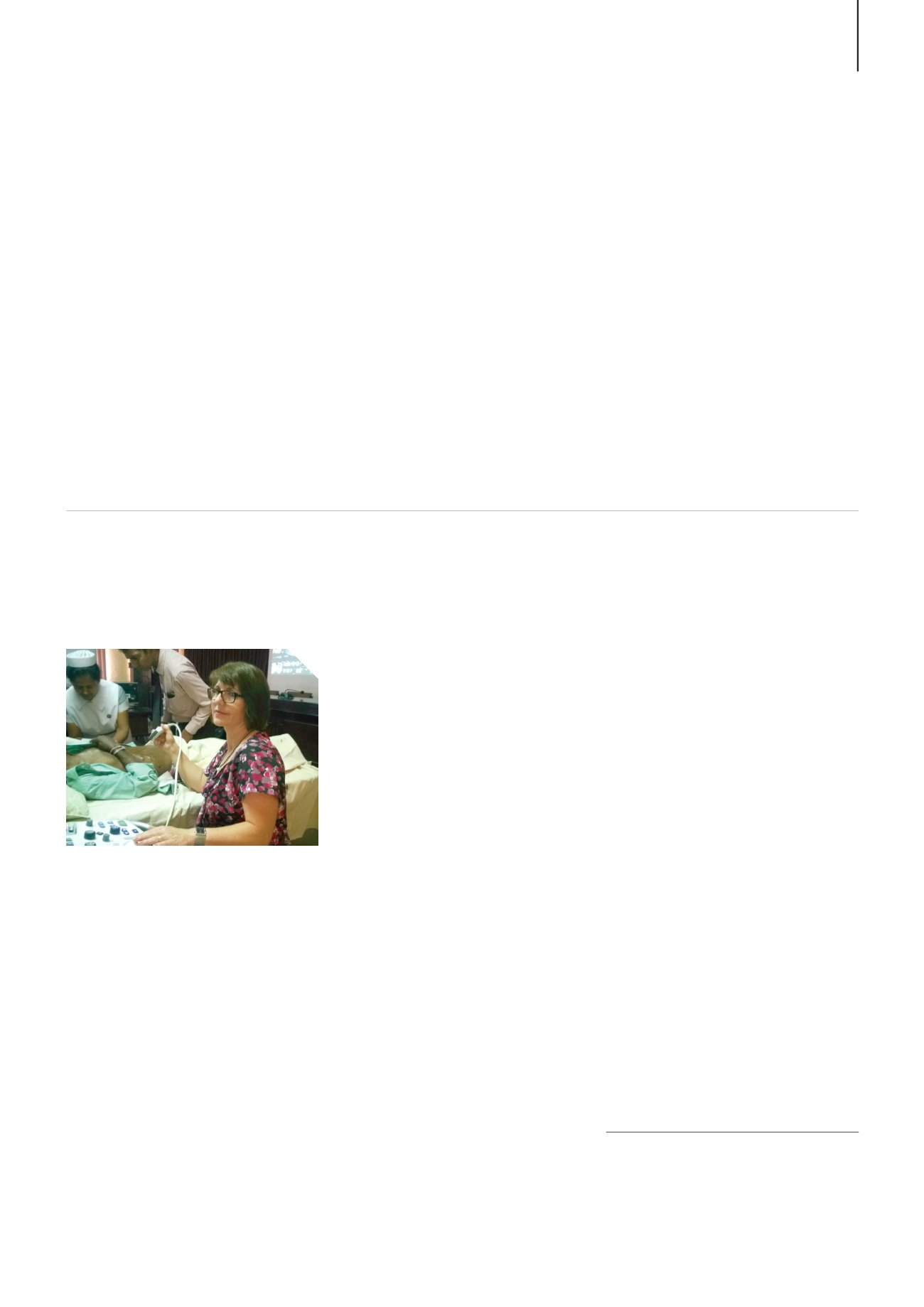
Marilyn Zelesco
examining a
volunteer patient