


 29 / 32

regular
ParaQuad News • Issue 1 Autumn 2016
29
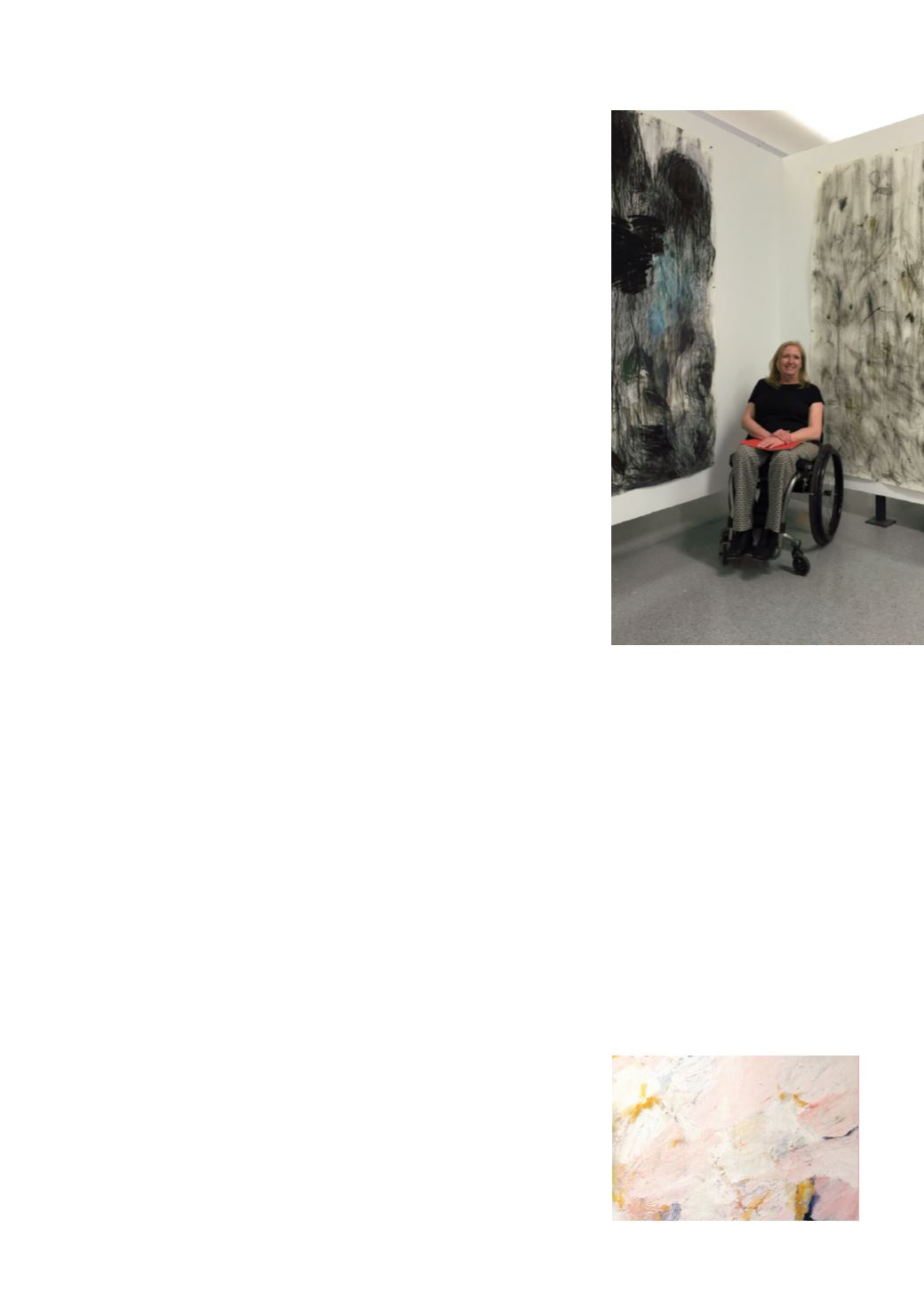
iz works primarily with oils
on canvas or charcoal and
ink on paper, but recently
began working with video.
She enjoys the physical challenge of
creating large works and employs
interesting techniques to cover the
large canvases, often laying the
work on the floor and using mops
or long sticks to cover the surface,
or hanging works and moving them
around to reach.
A Northwest Sydney resident,
Liz received a $5000 ParaQuad
Scholarship in 2015 and says the
greatest gift of being awarded the
scholarship was knowing she could
use her precious time studying visual
arts at Sydney University productively,
with the cost of resources and
materials taken care of.
“Knowing that my financial burden
of fees and expenses would be
covered brought a great relief to my
family and me.
The ParaQuad scholarship meant
I could begin to branch out and
experiment with my art making. It was
a privileged and special time to be
able to study and explore, knowing
that I could afford to use materials
that could see me realise the potential
of new ideas.”
Liz sustained a complete spinal
cord injury at T8 as a result of a
motorbike accident when she was
19 years old. She had always been
interested in creating art but only
became serious about art after she
had children. She told
ParaQuad
News
about her passion for art.
“I have been interested in creating
art since I was very young. I studied
art in high school and won a prize
in year 10 for a work that was
painted onto the walls of our school
gymnasium. Since that time, I have
been interested in the way art can
affect the way people see and feel
things.
After my accident I continued
to work, but it wasn’t until I had
my children that I became serious
(about art) again. I began painting
my children as they played in the
backyard and began to sell through
galleries and art shows. Throughout
this time I was involved in art
workshops with leading Australian
artists as well as running workshops
of my own at my children’s primary
school, acting as convenor of the
school art show up until recently (for
about 18 years or so!) and privately
from my home studio. It was then
that I decided to open a gallery of
my own and sell my works as well
as other people’s work, thinking that
I would have time to paint as well.
The gallery was great and I met a lot
of other artists and had some great
shows. I didn’t get much time to paint
at all however, as I was busy running
a business, so after a few years I
decided to close the gallery and work
on developing my own practice.
I eventually went back to study a
Diploma of Fine Arts at Hornsby TAFE
and then continued on to complete
my degree in Visual Arts at Sydney
College of the Arts (SCA). There I
was exposed to an explosion of
information — the theory component
of the course really opened different
ways of thinking as we studied
theorists, philosophers and artists.
It helped me to develop my own
artistic language and creative literacy.
Access was challenging to begin
with at SCA as the painting studios
for my cohort were upstairs and
of course there was no lift access.
Eventually I was given a studio on
the lower floor which I shared with a
Masters and PhD student. We spent
two years together and it worked out
well as they were able to influence
my work in ways that I couldn’t have
gained from being upstairs. I was
fortunate enough to win the Dean’s
award for drawing at our end of year
graduation show.
My work is maturing constantly and
I am currently preparing for my first
solo show in June this year.”
Liz’s love of art
Liz Green’s wheelchair is constantly covered
in paint and ink. When you are creating large,
oversized paintings using tools such as
mops and sticks, it’s not hard to see why.
Other facts about Liz
Liz spent the past 26 years as
a busy mother of four children,
local playgroup president and
parish council chairwoman.
She was also on the board of
one of her children’s schools.
L