



 24 / 32

24
ParaQuad News • Issue 1 Autumn 2016
northern region update
NSW Agency for Clinical Innovation (ACI)
http://www.aci.health.nsw.gov.au/__data/assets/pdf_file/0004/256297/Innovative_Service_Model_for_Chronic_Pain_Management_After_Spinal_Cord_Injury.pdf. Accessed 19/01/2016
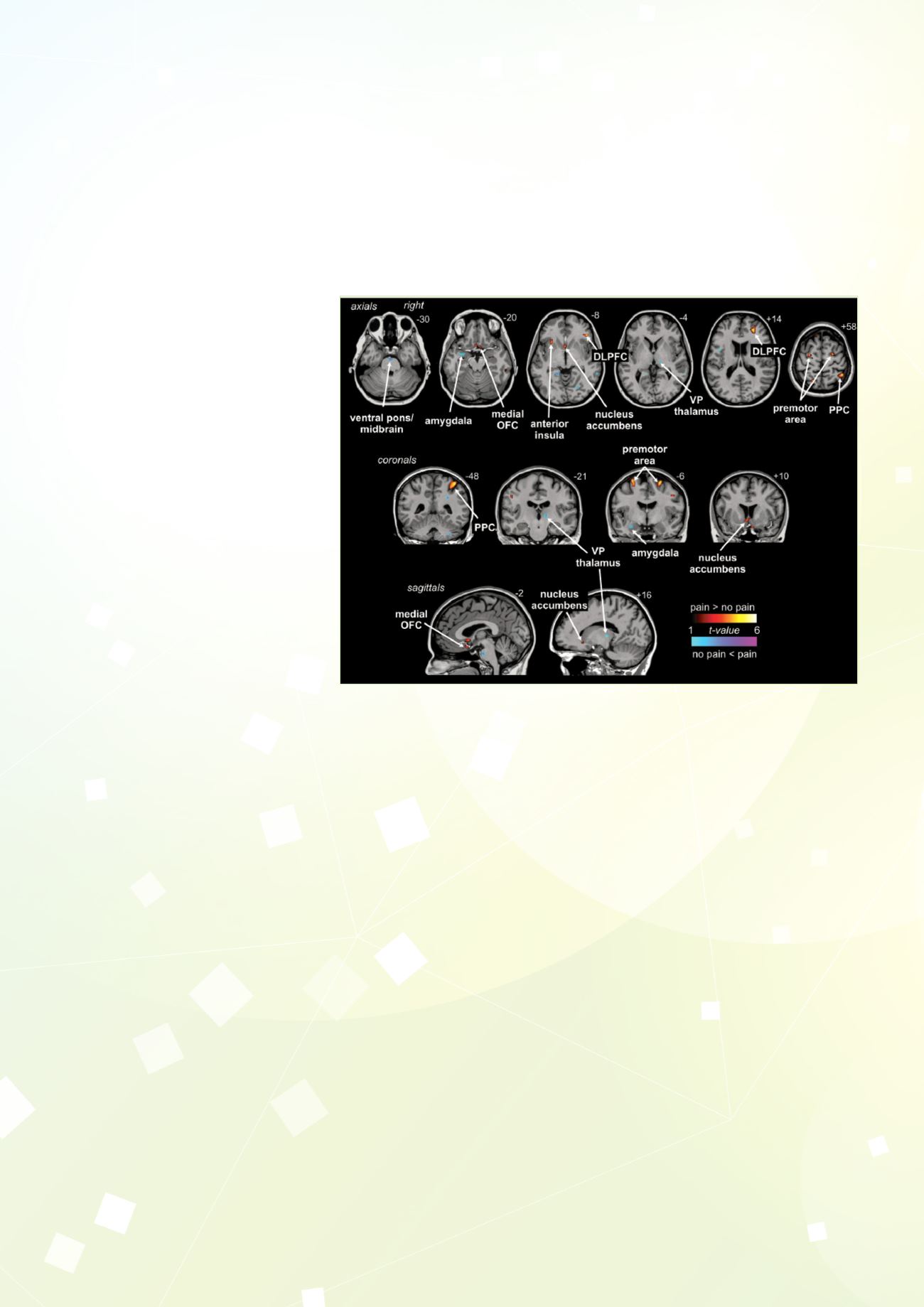
Above: Gustin et al. Celebral Cortex 2009, structural brain changes in people with SCI and pain compared to people with SCI but no pain.jpg
esearchers at the
University of New South
Wales and Neuroscience
Research Australia are
conducting a new study into the
brains of people with a complete
spinal cord injury (SCI), with the aim
of ultimately providing relief from
chronic pain.
Chief investigator Dr Sylvia Gustin
says the research explores what
happens in the brain as a result
of emotions and feelings about
pain. The study looks at neural
and motivational factors such as
depression and anxiety. According to
Dr Gustin emotional, cognitive and
sensory problems are key to subtle
brain changes in people who have
developed pain after a SCI.
“The problem with pain is that you
can’t see it — it is silent, but our
research shows people with pain
have subtle brain changes. I can
show study participants their brain
scans and we can visualise their
pain. Participants can have a very
emotional response when they see
their MRI scans.”
Dr Gustin is a clinical psychologist
who specialises in MRI. Her passion
for her work was evident when she
spoke with ParaQuad News. The
study involves having an MRI scan
at Neuroscience Research Australia,
part of UNSW, and completing
psychological questionnaires. “I
scan a participant’s brain for two
hours in an MRI scanner. I love
working with people with a SCI,
they are very helpful. They tell me
their stories and I have learnt a lot
from them.”
Chronic pain is experienced by
around 80% of individuals after spinal
cord injury (SCI), with 30% reporting
severe pain. Dr Gustin says research
indicates approximately two thirds of
people with a SCI develop ongoing
neuropathic pain in their legs but it is
unclear why. “Unfortunately, there is
no simple answer.”
“We have been at the forefront of
discovering the critical role of the brain
in the development and maintenance
of chronic neuropathic pain after SCI.
In previous research we showed that
this type of pain was associated with
brain activity which can disturb central
processing and play a key role in the
persistent experience of ongoing pain.”
The research found that inhibitory
brain cells normally blocking pain in
the thalamus (the gateway between
the peripheral and central parts of
the brain) have reduced functioning
in people with SCI, indicating that the
brain might have lost its ability to inhibit
sensory information and pain and
sensory signals are amplified, resulting
in the experience of chronic pain.
“This loss of inhibition means
brain activity changes that are then
perceived as pain. Every sensory
piece of information is emphasised.
Like a border being opened, every
pain is experienced more so.”
The research project has hit the
halfway mark but more volunteers
are needed. If you would like to
volunteer,contact:
Dr Sylvia Gustin, School of
Psychology, UNSW, Neuroscience
Research Australia 0413 278 336
s.gustin@unsw.edu.auUnlocking the Reasons for
Neuropathic Pain in SCI
What if chronic pain could be alleviated by the primary
source of pain: the human brain?
R